
How to Tell When Your Starter Is Ready to Bake
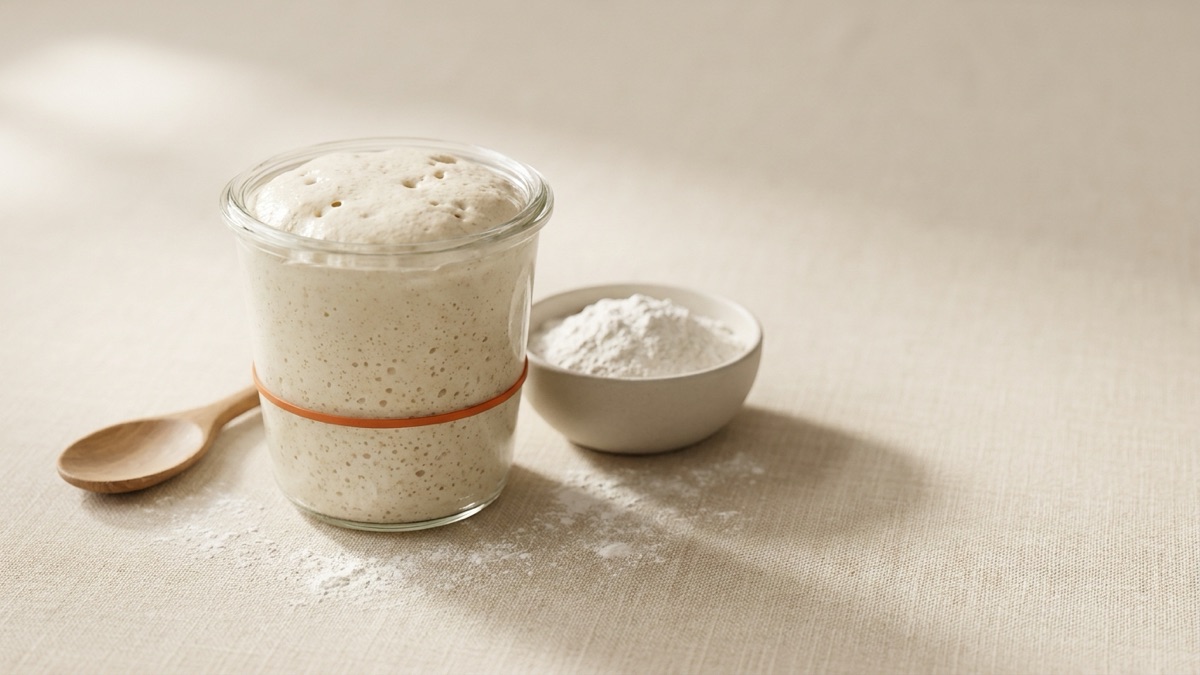
It is 7am, the jar is on the counter, and you want to know one thing: can you mix the dough now? The jar tells you, if you know where to look.
Quick answer
A sourdough starter is ready at or near its peak: risen about double past the band you put on at feeding, a domed top just starting to flatten, bubbles of mixed sizes to the top, and a sweet, mildly sour smell. The float test is only a rough hint. A starter that has fallen is fine after a feed.
The read
Doubled past the band, domed or just flattening, bubbly all the way up and smelling yeasty and mildly sour: mix your dough now. If it is still climbing with a rounded top, it is Not yet, so give it more time somewhere warm. If it has sunk below a streaky line on the glass, it is Past its peak: feed it and use it at the next peak.
Key takeaways
- Ready has two parts: a starter mature enough to raise bread, and a jar at the right moment today, near its peak after a feed.
- Mark the fed level with a rubber band. A rise of about double past the band, with a domed top just starting to flatten, is the sign that matters most.
- The float test is a rough hint, not proof. A float is a yes; a sink is only a maybe, and stiff or whole grain starters often sink at their peak.
- A starter that has fallen and left a tide line is past peak, not ruined. Just past peak still raises bread; well past, feed it and catch the next peak.
- Fuzzy mold of any color, or pink or orange streaks, means the whole jar goes. Never scrape it.
Is my sourdough starter ready? Two questions hiding in one
"Is it ready" is really two questions.
The first is maturity. Is this starter strong enough to raise a loaf at all? A four day old jar can bubble enthusiastically and still lack the strength to lift a dough. That gets answered once, over a week or two.
The second is timing. Is this mature starter at the right moment today? A strong starter can be ready every single day, a few hours after you feed it, and past its best a few hours after that. This is the question you answer every bake, and it is the one the rest of this guide is mostly about.
How long until a new starter is mature?
A new starter usually takes 7 to 14 days to become reliable, sometimes longer in a cool kitchen. Early on it often bubbles wildly for a day or two and then goes quiet around days 3 to 7. That lull is normal. Those first bubbles often come from bacteria that fade as the starter turns more acidic, and the yeast takes over after. Keep feeding at the same times each day.
It is mature when it rises predictably after every feed, at least doubling in about 4 to 12 hours, two or three days in a row. The range is wide because the feeding ratio and your room temperature change the timing so much. If you are still in the early days, how to make a sourdough starter walks through what each day tends to look like.
Good to know
A slow starter is almost always too cool, too young or underfed. A warm spot around 75 to 80F (24 to 27C) speeds it up, and a little whole wheat or rye in the feed brings more food.
What does a starter ready to use look like?
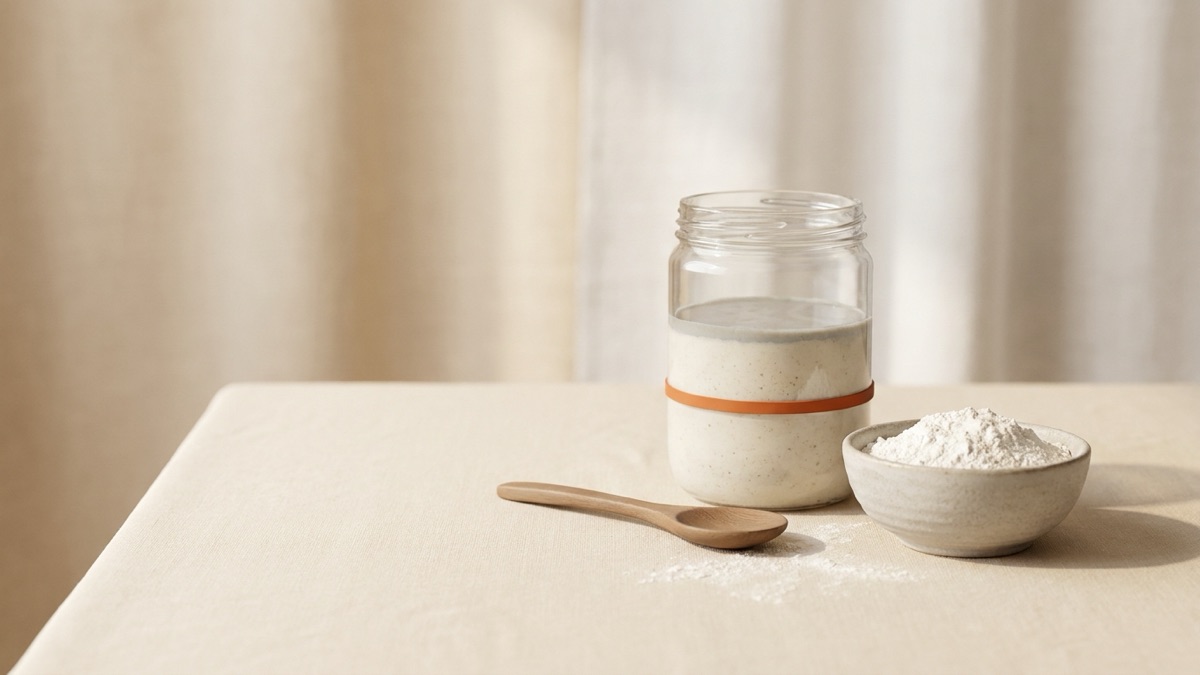
Put a rubber band or a strip of tape around the jar at the starter's level right after you feed it. Everything else is read against that line. Then look for these signs together, because any one of them alone can fool you:
- Rise: about double the height of the band, or a little more.
- Top: domed, or a dome that is just starting to flatten.
- Bubbles: many sizes, from pinheads to large ones, all through the side of the jar and right up to the top.
- Texture: light and webby when you dip in a spoon, a bit like mousse.
- Smell: pleasant, yeasty, a little sweet and mildly sour.

Use a clear, straight-sided jar and keep it no more than a third full right after feeding. That leaves room to see a true rise, and the starter will not climb out of the top. Keeping only 20 to 50 g between feeds makes that easy.
The sourdough starter peak: what each stage looks like
A starter moves through the same stages after every feed. The peak is the moment it stops climbing: the top has domed as high as it will go and is about to level off.
| Stage | What you see in the jar | Verdict | What to do |
|---|---|---|---|
| Quiet | Flat, level with the band, few bubbles | Not yet | Wait, somewhere warm |
| Waking up | Small bubbles, rise of about 10 to 40% | Not yet | Check again in an hour or two |
| Lively | Rise of about 50 to 90%, gentle dome, mixed bubbles | Not yet | Nearly there; watch the top |
| At its peak | About double or more, dome just flattening | Ready to bake | Mix your dough now |
| Falling | Sunken or wrinkled top, streaks above it | Past its peak | Fine soon after; well past, feed first |
The peak does not last all day. A few hours after it, the starter runs out of food and starts to sink. Use it within an hour or so of the peak if you can.
Past its peak: the tide line on the glass
When a starter falls, it leaves a streaky line on the glass where the top used to be. That tide line tells you it rose well and roughly how high.
A starter just below that line is still good to use. It has a little less lift left than at the very top, but it still raises bread well. One that has sunk well below the line, with a wrinkled surface and a sharper sour or nail polish smell, is hungry. It is not ruined. Feed it and use it at the next peak.
A little liquid on top of a falling starter is hooch, mostly alcohol and water from a hungry starter, and it is harmless. Pour it off for a milder flavor or stir it in for more tang, then feed.
Tip
If the starter keeps peaking and falling before you are ready to mix, that is good news: it is strong and fast. Slow it down with a bigger feed like 1:5:5, cooler water or a cooler spot.
Does the sourdough float test work?
The float test is simple. Drop a small spoonful of starter into a glass of water. If it floats, it is full of trapped gas, which is a good sign.
The trouble is what it misses. A float is a fair hint, but the test is not fully reliable and can give false positives. It also gives false negatives: a stiff starter, or one made with a lot of whole wheat or rye, often sinks even when it is ripe, because it holds gas differently from a wetter, mostly white flour starter. Scooping and stirring knock gas out before the spoonful even reaches the water.
So treat it this way: a float is a yes, and a sink is only a maybe. There is more on why in does the sourdough float test work.

A sourdough starter ready to bake test you can trust
The best ready test is the one you already set up: the band. Before you mix, ask four questions in order.
- Has it roughly doubled past the band?
- Is the top domed, or just starting to flatten, rather than still rounding up or already sunken?
- Do bubbles of many sizes run all the way up the glass?
- Does it smell yeasty and mildly sour, not sharply sour or like nail polish?
Four yeses: Ready to bake. A rise that is still climbing: Not yet. A fall below the tide line: Past its peak. If your eyes and the band disagree with a float test, trust the band.
How to make the peak land when you want to mix
Work backward from the time you want to mix. If your starter peaks 6 hours after a 1:2:2 feed, feed it 6 hours before you plan to mix. If that means feeding at an awkward hour, change the ratio rather than your sleep.
A feeding ratio is starter to flour to water by weight, so 1:5:5 is 20 g starter with 100 g flour and 100 g water. At about 75F (24C), these are the usual rules of thumb, faster in a warm room and slower in a cool one:
- 1:1:1 peaks in about 4 to 6 hours.
- 1:2:2 peaks in about 6 to 8 hours.
- 1:5:5 peaks in about 8 to 12 hours, handy for a feed at night and a mix in the morning.
- 1:10:10 takes 12 hours or more, useful in a hot kitchen.
Sourdough starter feeding ratios goes deeper on what each ratio does to timing and flavor. A higher ratio used right at the peak also gives a milder bread.
If your starter lives in the fridge, take it out the day before you bake and give it one or two feeds at room temperature. The first feed may not double. That is normal, and by the second it is usually back to form. Keeping a sourdough starter in the fridge covers the routine.
Try it
Pick a ratio and the grams you keep in the starter feeding calculator, and it shows the flour and water to add and the usual window to peak for your room.
For the bigger picture on keeping a starter, from feeding to discard to the fridge, the starter care guides gather everything in one place.
What to do today
- Feed the starter, weighing everything, and put a rubber band at the new level.
- Note the time and the room temperature.
- Check the jar every hour or two once it starts to rise. Look at the band, the top and the bubbles on the side.
- Mix your dough when it has doubled and the dome is just starting to flatten.
- If you miss the peak, look for the tide line. Just below it, bake anyway. Well below it, feed and catch the next peak.
- Write down how many hours it took to peak at that ratio. Next time you can plan the feed around it.
When to start again
A starter that is slow, hungry or past its peak just needs feeding. A few signs are different: they mean the whole starter goes, every time, with no scraping and no saving the good part. Mold sends threads through a starter well beyond the spot you can see, so a fuzzy or pink starter is discarded, never scraped. Discard the whole starter if you see:
- fuzzy mold of any color: white, green, blue, gray or black fuzz on the starter or on the jar where it touches the starter;
- pink, orange or red streaks, patches or tinted liquid anywhere in the jar;
- a rotten, putrid or truly foul smell, very different from sour, yeasty, boozy or nail polish;
- a slimy, stringy texture or a slick film that does not stir back in.
Heads up
If anything on the surface is raised or fuzzy, or you cannot tell, treat it as mold. That is Start fresh: discard the whole jar, wash it in hot, soapy water, rinse it well and begin again with fresh flour and water.
These look alarming but are normal, and only need a feed:
- Hooch: gray, brown or dark liquid on top. Pour it off or stir it in, then feed.
- A dry skin on top from a jar that was not covered, as long as nothing is fuzzy. Remove it and feed from the soft starter underneath.
- An acetone or nail polish smell. The starter is hungry, so feed it, and feed a little more often.
- A quiet day for a young starter. Days 3 to 7 often go still before it wakes up for good.
- Dark liquid after a week in the fridge. Pour it off or stir it in, then give it one or two feeds at room temperature.
When in doubt, throw it out. A new starter costs a little flour and a week or two, and it is never worth keeping one you are unsure about.
The Loaf Scout app reads one photo of the jar from the side and gives you the rise against the band, the activity and whether it is ready, as a second opinion next to your own eyes and nose. Either way, the routine is the same: feed, mark the band, watch for the doubled dome, and mix when it is ready.
The pictures in this guide are AI-generated illustrations, not photos of real bakes; real loaves and starters vary, so trust the signs described in the text over any picture. Loaf Scout guides are general baking guidance, written from the sources named below, and every kitchen, flour and oven is a little different. Loaf Scout gives an AI read of one photo; your own eyes, nose and the poke test still count. A starter with fuzzy mold of any color, pink or orange streaks, or a rotten smell is thrown out and started again, whatever any page says.
Questions people ask
How do I know when my sourdough starter is ready to use?
It has risen about double past the band you put on the jar at feeding, the top is domed or just starting to flatten, bubbles of many sizes run right up the glass, and it smells yeasty, a little sweet and mildly sour. Use it at or near that peak.
Can I still use my sourdough starter after it peaks?
Yes. A starter just past its peak still raises bread well. If it has fallen well below the streaky tide line it left on the glass, feed it and use it at the next peak for the best rise.
Does the float test work for sourdough starter?
Only as a rough hint. A spoonful that floats is full of gas, which is a good sign, but a stiff or whole grain starter can sink even at its peak and scooping knocks gas out. The rise against the band is the better guide.
How long after feeding is a sourdough starter ready?
At about 75F (24C), a 1:1:1 feed usually peaks in about 4 to 6 hours, 1:2:2 in about 6 to 8, 1:5:5 in about 8 to 12 and 1:10:10 in 12 hours or more. Warm rooms are faster and cool rooms slower, so watch your own jar.
How long does a new sourdough starter take to be ready?
Usually 7 to 14 days, sometimes longer in a cool kitchen. It is mature when it at least doubles in about 4 to 12 hours after each feed, two or three days in a row.
Sources
- The Perfect Loaf: The ultimate sourdough starter guide: www.theperfectloaf.com/guides/sourdough-starter/
- The Perfect Loaf: Frequently asked sourdough starter questions: www.theperfectloaf.com/frequently-asked-sourdough-starter-questions/
- Colorado State University Extension: Sourdough starter best practices: extension.colostate.edu/resource/sourdough-starter-best-practices/
- King Arthur Baking: Sourdough starter troubleshooting: www.kingarthurbaking.com/blog/2018/03/09/sourdough-starter-troubleshooting-2
- King Arthur Baking: Liquid on top of sourdough starter is totally fine: www.kingarthurbaking.com/blog/2023/08/28/liquid-on-top-of-sourdough-starter
Read next
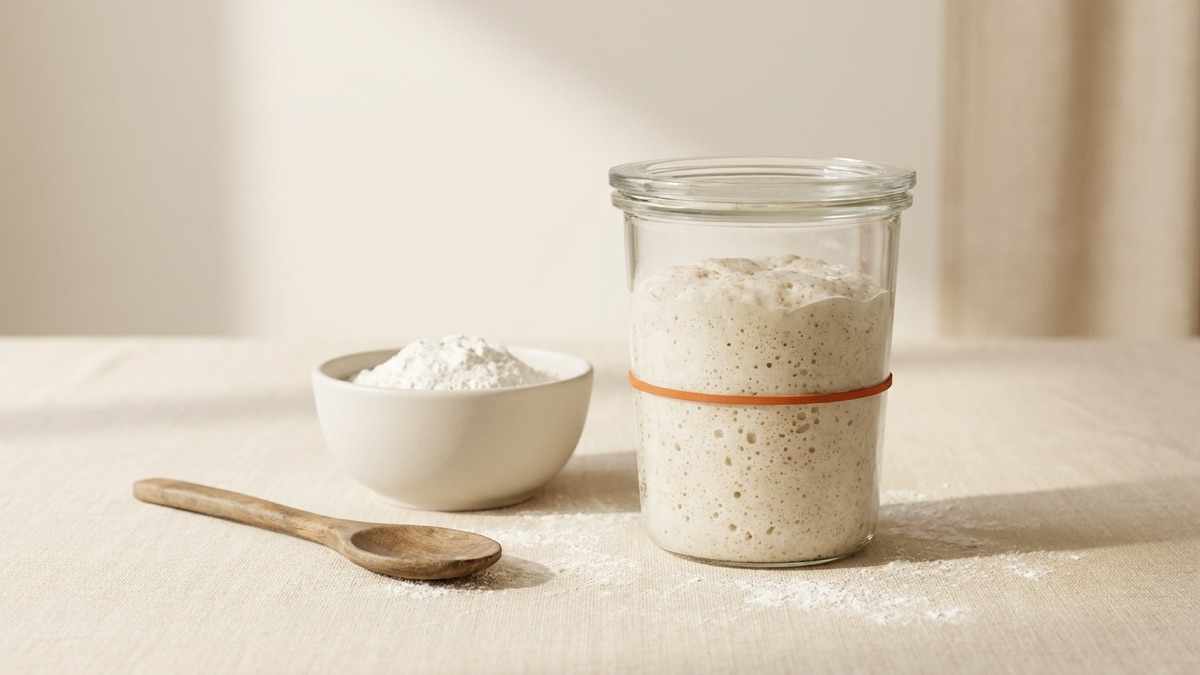
Starter care
Sourdough Starter: A Plain Guide to Keeping One


Shaping, scoring and baking
How to Get an Ear on Sourdough
Bulk and proofing
How Long to Proof Sourdough After Shaping
Starter problems
Hooch on Sourdough Starter: What the Liquid Means