
Sourdough Starter: A Plain Guide to Keeping One
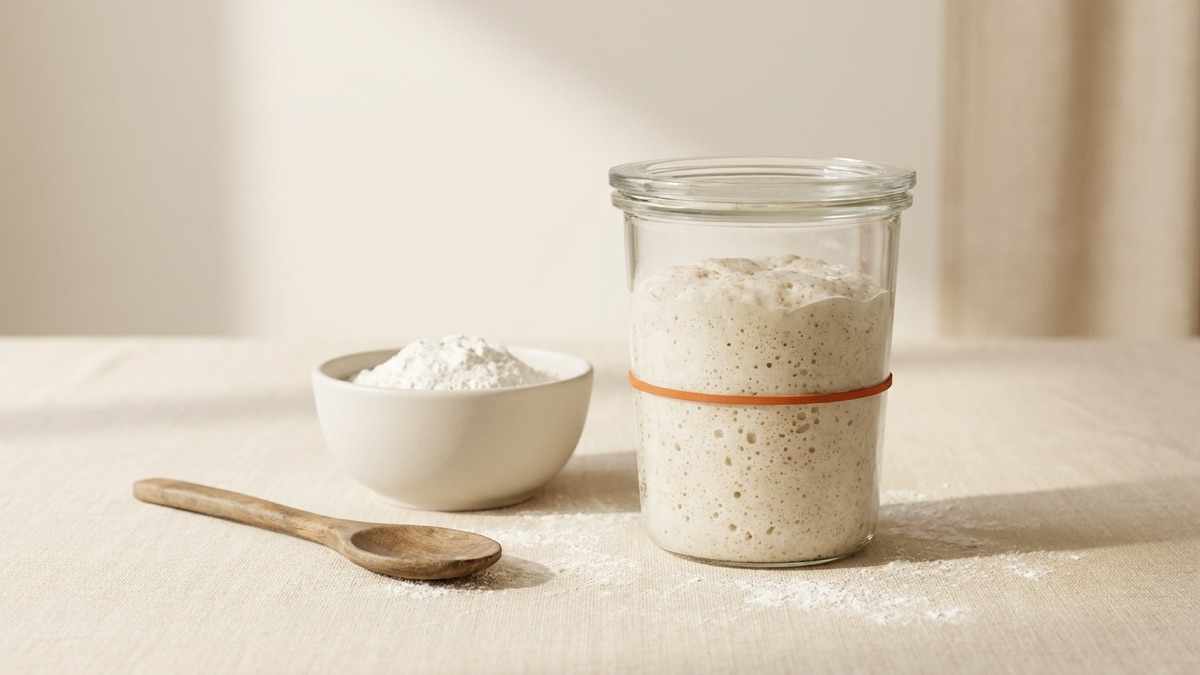
A sourdough starter is the jar of bubbly flour and water that every sourdough loaf begins with. Keeping one is simpler than the internet makes it look: feed it, mark it, watch it, and learn the few signs that mean it has to go.
Quick answer
A sourdough starter is flour and water fermented by wild yeast and bacteria. Keep a small amount, 20 to 50 g, in a clear jar with a loose lid. Discard and feed it once or twice a day on the counter, or weekly in the fridge, and bake with it when it has doubled and domed.
The read
A starter that has doubled past the band, has a domed top just starting to flatten and smells yeasty and mildly sour is ready, so mix your dough. Still climbing with a rounded top is Not yet; sunk below a streaky line on the glass is Past its peak, so feed it first. Any fuzzy mold or pink or orange color is Start fresh: discard the whole jar.
Key takeaways
- A starter is a living culture of wild yeast and lactic acid bacteria in flour and water. It needs regular food and a loose lid, not special gear.
- Keep it small: 20 to 50 g between feeds in a clear, straight-sided jar that is no more than a third full after feeding.
- Counter for bakers who bake often and feed daily; fridge for bakers who bake weekly or less.
- Most starters are fed equal weights of flour and water, which gives a thick batter. Weigh everything.
- Fuzzy mold of any color, or pink, orange or red streaks, means the whole starter goes, never scraped.
What is a sourdough starter?
A sourdough starter is flour and water that has been left to ferment and fed regularly until it is full of wild yeast and lactic acid bacteria. Those microbes are already on the flour, so you do not add packaged yeast to make one.
The yeast makes the gas that raises the bread. The bacteria make the acids that give sourdough its tang and drop the starter below a pH of 4.6, which helps keep unwanted microbes out.
You will also see the word levain: a portion of starter built up for one particular dough. The jar you keep going is the starter; the bowl you build for Saturday's loaf is the levain.
If you do not have a starter yet, how to make a sourdough starter walks through what each day of the first week or two looks like.
How to keep a sourdough starter
One routine, repeated: discard, feed, mark, watch.
- Discard. Keep only 20 to 50 g of the old starter and remove the rest. Fresh flour does its job better when it is not swamped by old, acidic starter.
- Feed. Add fresh flour and water by weight. A 1:1:1 feed is 20 g starter, 20 g flour and 20 g water. A 1:5:5 feed is 20 g starter with 100 g flour and 100 g water.
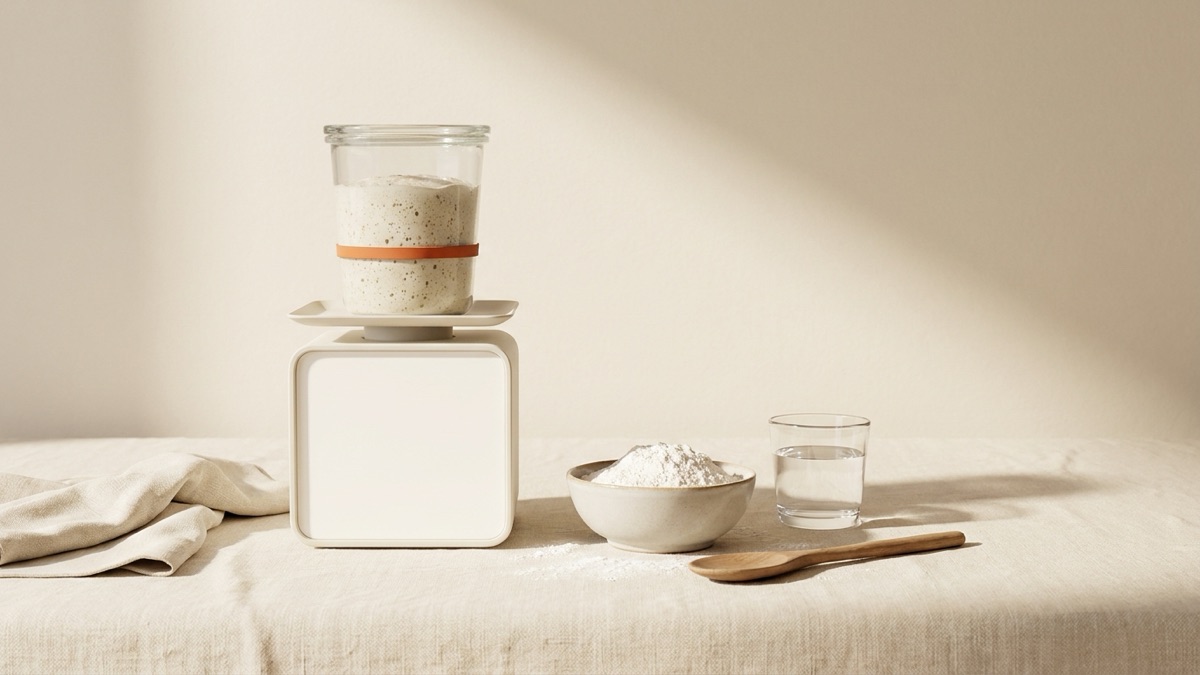
- Mark. Put a rubber band or a strip of tape around the jar at the starter's level right after feeding. Every rise is read against that line.
- Watch. Over the next several hours it rises, domes, peaks and sinks back down.
The ratio sets the clock. At about 75F (24C), a 1:1:1 feed usually peaks in about 4 to 6 hours and a 1:5:5 feed in about 8 to 12. Sourdough starter feeding ratios has the full chart.
Try it
Put the grams you keep and the ratio you want into the starter feeding calculator. It gives you the flour and water to add and the usual window to the peak for your room.
Temperature matters as much as the ratio. A slow starter perks up somewhere around 75 to 80F (24 to 27C); cold slows it right down, and a very hot spot can make it run too fast.
Sourdough starter jar: what to keep it in
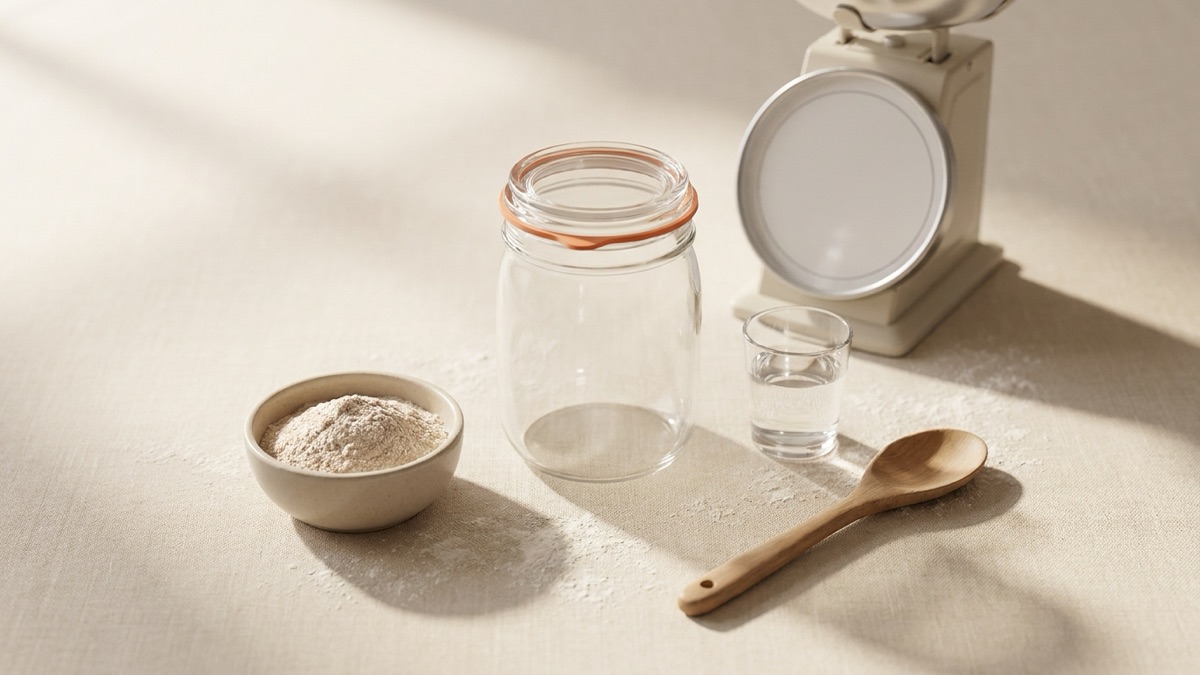
- Clear glass so you can see the rise, the bubbles and the streaky line it leaves when it falls. Crockery, stainless steel and food-grade plastic also work, but you lose the view.
- Straight sides, so a rise is easy to judge against the band.
- Room to grow. Right after feeding, the starter should fill no more than a third of the jar, so you see its peak rather than find it on the counter.
- A loose lid resting on top, or a cloth. It keeps dust and mold spores out and lets gas escape.
Move the starter into a clean jar when the sides get crusted with dried starter.
Sourdough starter consistency: how thick should it be?
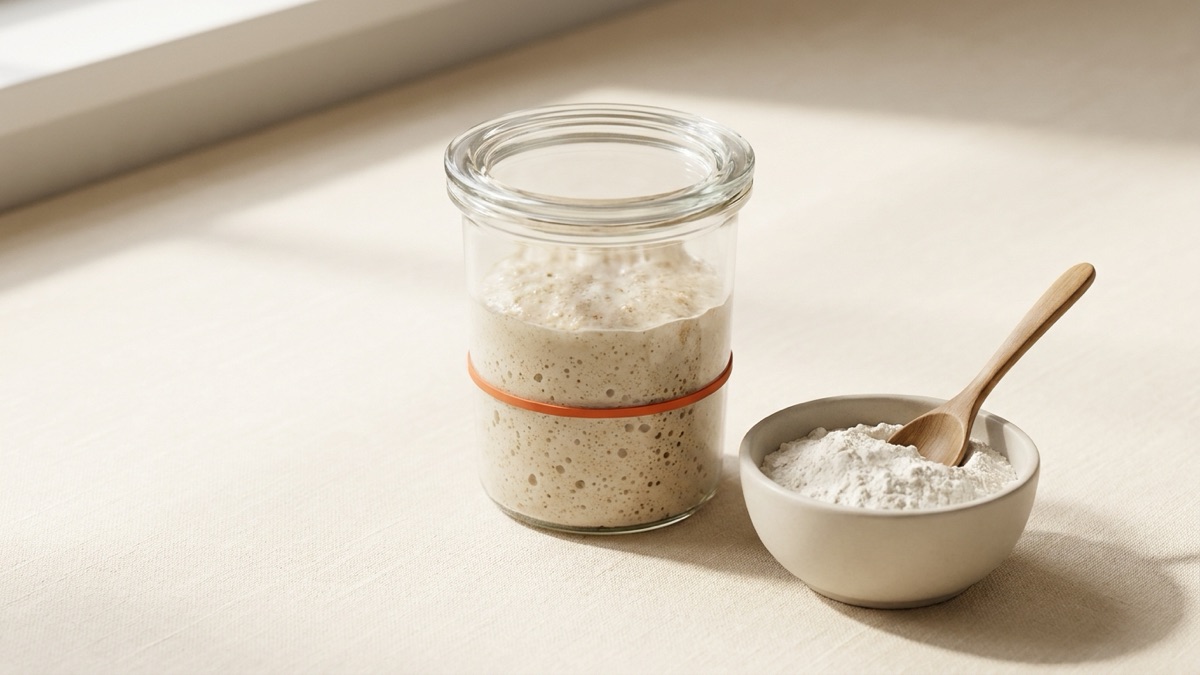
Most home starters are fed equal weights of flour and water. Bakers call that a 100 percent hydration starter, because the water weighs 100 percent of the flour. Freshly fed, it looks like thick batter, a bit like pancake batter that holds a soft shape on the spoon.
At the peak it turns light, airy and webby; after the peak it loosens and turns soupier.
Some bakers keep a stiff starter instead, with water around 50 to 65 percent of the flour weight. It feels like a soft dough and leans tangier. If you are just starting out, stay with equal weights, because nearly every home recipe assumes it.
Good to know
A starter that is always thin and watery is usually past its peak or a touch too wet. Feed it sooner, or try 50 g flour to 40 g water.
Sourdough starter fridge or counter?
| Where | Best for | How often to feed | Before you bake |
|---|---|---|---|
| Counter | Baking several times a week | Once or twice a day, same times | Feed so the peak lands when you mix |
| Fridge, 38 to 40F (3 to 4C) | Baking weekly or less | About once a week | One or two feeds at room temperature the day before |
On the counter, the starter is always nearly ready, peaking a few hours after each feed. The cost is flour and a daily habit.
In the fridge, feed it, leave it at room temperature for 1 to 2 hours, then refrigerate it. It can sit a week or more between feeds. Dark liquid on top after that is hooch, mostly alcohol and water from a hungry starter; pour it off or stir it in. The day before you bake, give it one or two feeds at room temperature. The first feed often does not double, which is normal. Keeping a sourdough starter in the fridge goes deeper on the routine.
What do you do with the discard?
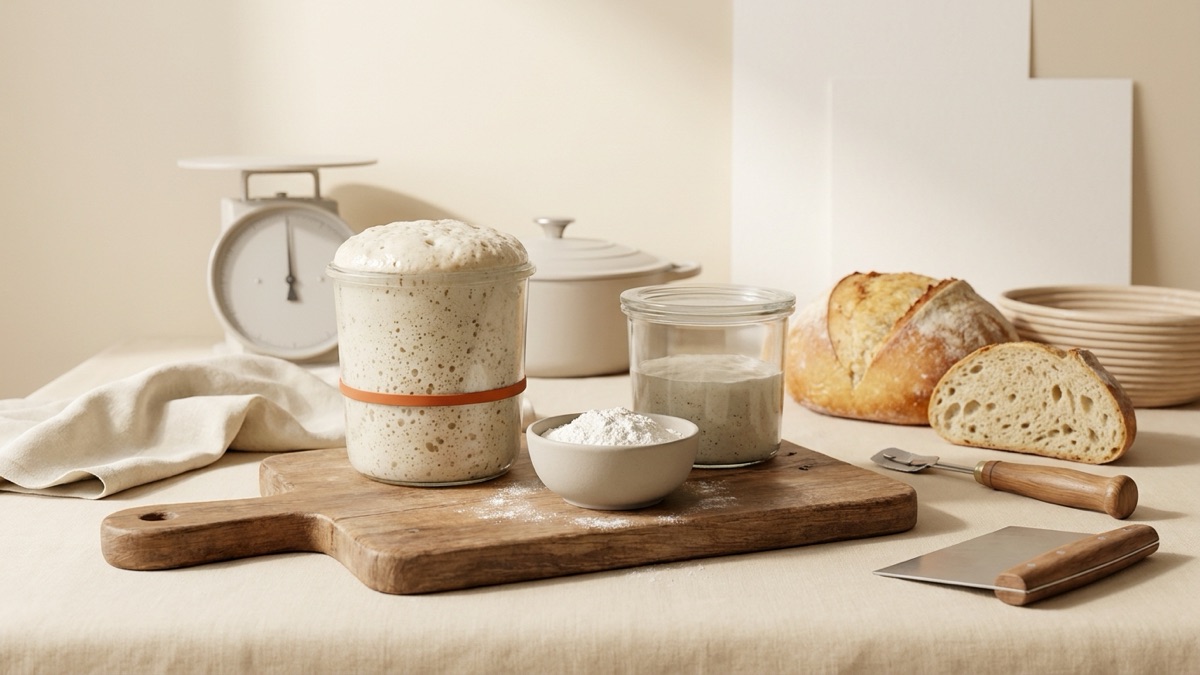
The starter you remove before each feed is called discard. Keeping only 20 to 50 g keeps it small. Throw it out, or save it in a covered jar in the fridge for recipes that use unfed starter; sourdough discard covers what to do with it.
How do you know a starter is ready to bake with?
First, it has to be mature: at least doubling in about 4 to 12 hours after each feed, two or three days in a row. A new starter usually takes 7 to 14 days to get there. Second, it has to be near its peak today: double the band, a domed top just starting to flatten, bubbles of many sizes and a yeasty, mildly sour smell. How to tell when your starter is ready covers the peak and the float test.
For everything else about feeding, timing and keeping a starter, the starter care guides are gathered in one place.
What to do today
- Weigh out 20 to 50 g of your starter into a clean, clear jar and discard the rest.
- Feed it by weight, 1:1:1 if you want to bake today or 1:5:5 if you want it to peak overnight.
- Put a rubber band at the new level and rest the lid on loosely.
- Check it every hour or two once it moves, and write down when it peaks.
- Decide counter or fridge based on how often you really bake.
When to start again
A slow, hungry or past-peak starter only needs a feed. A few signs mean the whole starter goes, every time. Mold sends threads through a starter well beyond the spot you can see, so a fuzzy or pink starter is discarded, never scraped. Discard the whole starter if you see:
- fuzzy mold of any color: white, green, blue, gray or black fuzz on the starter or on the jar where it touches the starter;
- pink, orange or red streaks, patches or tinted liquid anywhere in the jar;
- a rotten, putrid or truly foul smell, very different from sour, yeasty, boozy or nail polish;
- a slimy, stringy texture or a slick film that does not stir back in.
Heads up
If anything on the surface is raised or fuzzy, or you cannot tell, treat it as mold. That is Start fresh: discard the whole jar, wash it in hot, soapy water, rinse it well and begin again with fresh flour and water.
These look alarming but are normal, and only need a feed:
- Hooch: gray, brown or dark liquid on top. Pour it off or stir it in, then feed.
- A dry skin on top from a jar that was not covered, as long as nothing is fuzzy. Remove it and feed from the soft starter underneath.
- An acetone or nail polish smell. The starter is hungry, so feed it, and feed a little more often.
- A quiet day for a young starter. Days 3 to 7 often go still before it wakes up for good.
- Dark liquid after a week in the fridge. Pour it off or stir it in, then give it one or two feeds at room temperature.
When in doubt, throw it out. A starter is not fussy once it has a routine: keep it small, feed it by weight, mark the band, and let the jar tell you when it is ready.
The pictures in this guide are AI-generated illustrations, not photos of real bakes; real loaves and starters vary, so trust the signs described in the text over any picture. Loaf Scout guides are general baking guidance, written from the sources named below, and every kitchen, flour and oven is a little different. Loaf Scout gives an AI read of one photo; your own eyes, nose and the poke test still count. A starter with fuzzy mold of any color, pink or orange streaks, or a rotten smell is thrown out and started again, whatever any page says.
Questions people ask
What is a sourdough starter?
A sourdough starter is a mix of flour and water that wild yeast and lactic acid bacteria have colonized. Fed regularly, it rises and bubbles, and a spoonful of it at its peak leavens and flavors a loaf of sourdough bread without any packaged yeast.
Should I keep my sourdough starter on the counter or in the fridge?
Keep it on the counter if you bake several times a week and can feed it once or twice a day. Keep it in the fridge at about 38 to 40F (3 to 4C) if you bake weekly or less; it can sit a week or more between feeds there.
What consistency should a sourdough starter be?
Most home starters are fed equal weights of flour and water, which gives a thick batter, a bit like pancake batter that holds a soft shape. After it rises it turns light, airy and webby, and it loosens again as it falls.
What kind of jar is best for a sourdough starter?
A clear, straight-sided glass jar with a loose lid, big enough that the starter fills no more than a third of it right after feeding. Clear glass lets you see the rise against a rubber band, and a loose lid lets gas out.
How often do I need to feed a sourdough starter?
On the counter, once or twice a day at about the same times. In the fridge, about once a week, with one or two feeds at room temperature the day before you bake.
Sources
- Colorado State University Extension: Sourdough starter best practices: extension.colostate.edu/resource/sourdough-starter-best-practices/
- The Perfect Loaf: The ultimate sourdough starter guide: www.theperfectloaf.com/guides/sourdough-starter/
- The Perfect Loaf: Frequently asked sourdough starter questions: www.theperfectloaf.com/frequently-asked-sourdough-starter-questions/
- King Arthur Baking: Sourdough starter recipe: www.kingarthurbaking.com/recipes/sourdough-starter-recipe
- King Arthur Baking: Sourdough starter troubleshooting: www.kingarthurbaking.com/blog/2018/03/09/sourdough-starter-troubleshooting-2
- King Arthur Baking: Liquid on top of sourdough starter is totally fine: www.kingarthurbaking.com/blog/2023/08/28/liquid-on-top-of-sourdough-starter
Read next
Starter care
How to Tell When Your Starter Is Ready to Bake
Reading the crumb
Fool's Crumb: The Gap Under the Crust
Bulk and proofing
The Sourdough Poke Test, and When Not to Trust It
Shaping, scoring and baking
Baking Sourdough in a Dutch Oven: Heat, Lid and Timing