
Guides Shaping, scoring and baking
Baking Sourdough in a Dutch Oven: Heat, Lid and Timing
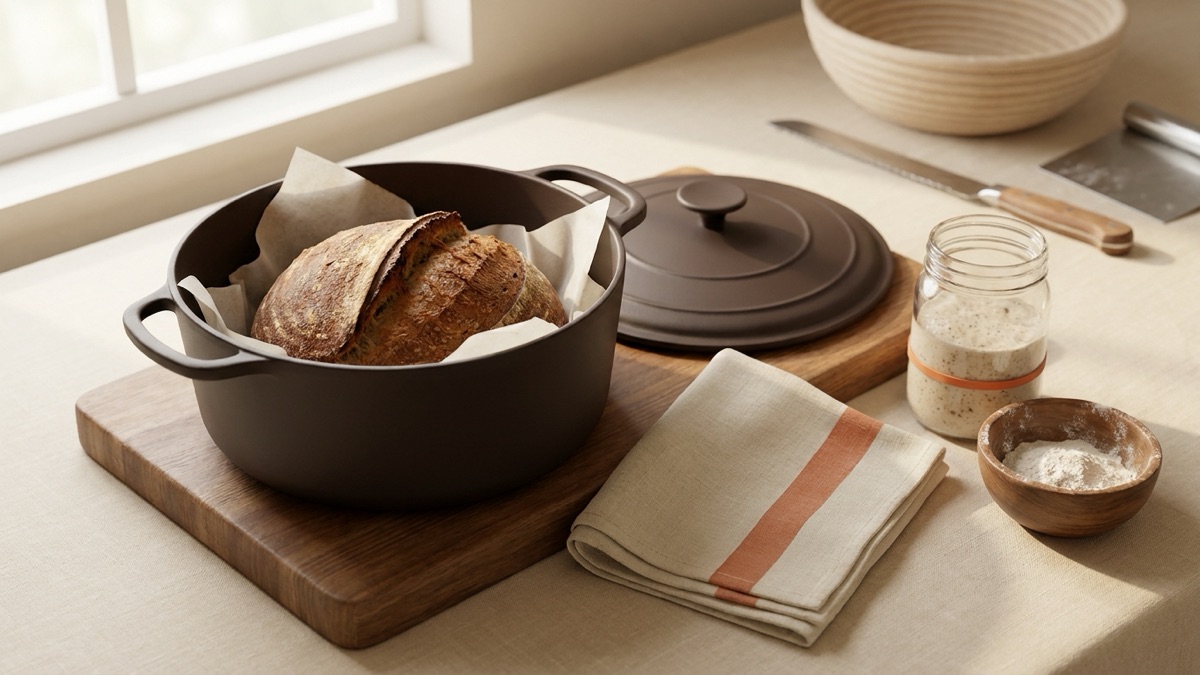
The dough is shaped, proofed and waiting, and the last thing between you and bread is a very hot, very heavy pot. Most of what goes wrong here is small: a lid lifted too early, a pot that was not hot enough, a rack one notch too low. The pot does most of the work if you let it.
Quick answer
To bake sourdough in a dutch oven, preheat the pot and its lid for 45 to 60 minutes at 450 to 500F (230 to 260C). Lower the scored dough in on parchment, bake covered about 20 minutes, then uncovered another 20 to 25, until deep brown and about 205 to 210F (96 to 99C) inside.
The read
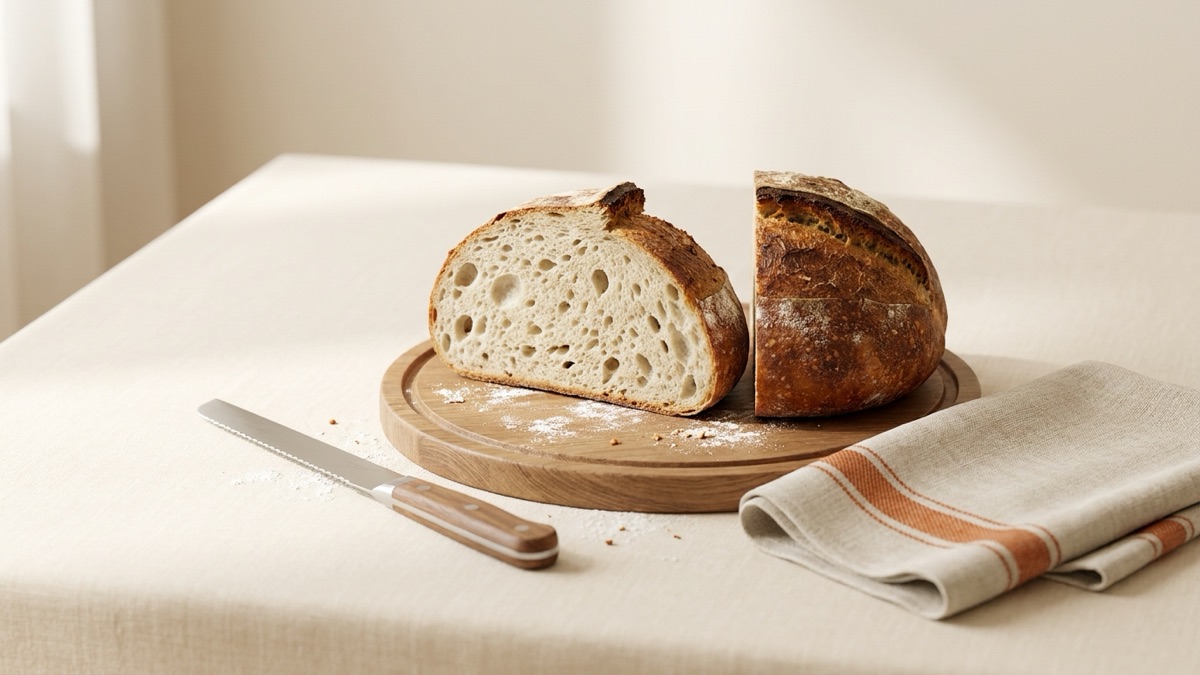
If the loaf rose well and the crumb is even but the top is pale or the base is too dark, the fermentation is right and what is left is the bake. For a pale top, bake uncovered 5 to 10 minutes longer. For a dark base, move the pot up one rack. Change one and leave the rest alone. Tall, deep brown and crisp all over is Bake it again.
Key takeaways
- A covered heavy pot traps the dough's own steam, which keeps the crust soft while the loaf rises.
- Preheat the pot and the lid together for a full 45 to 60 minutes, unless the maker says not to heat it empty.
- Lid on for about the first 20 minutes, lid off for the last 20 to 25. The first part is for rise, the second for color.
- A 4 to 5 quart pot fits the usual single loaf.
- The pot and its steam are very hot. Use a parchment sling and dry oven mitts, and lift the lid away from your face.
Why bake dutch oven sourdough bread?
A dutch oven is any heavy pot with a tight lid. It solves the one thing a home oven is bad at: holding steam. Home ovens vent, so moisture escapes.
In a closed pot, the dough gives off its own moisture and the lid traps it. For the first part of the bake that steam keeps the surface of the loaf soft and stretchy, so it can keep expanding before the crust sets. It also helps the crust brown and shine. Without steam the crust sets and dries early, and the score cannot open.
Steam is only wanted early. Too much moisture all the way through leaves a thick, rubbery crust, which is why the lid comes off for the second half. That early steam is also one of the four things behind a sourdough ear.
How to bake sourdough in a dutch oven, step by step
| Step | Oven | How long |
|---|---|---|
| Preheat the pot and lid | 450 to 500F (230 to 260C) | 45 to 60 minutes |
| Score, then lower the dough in on parchment | Under a minute | |
| Bake with the lid on | Same setting | About 20 minutes |
| Bake with the lid off | Same, or 25F (14C) lower if it darkens fast | 20 to 25 minutes, until deep brown |
| Cool on a wire rack | At least 1 to 2 hours |
If the dough proofed in the fridge, bake it straight from cold. Turn it out onto a sheet of parchment, score it right away, and use the parchment as a sling to lower it into the pot. Cold dough holds its shape and scores cleanly.
Heads up
The pot is around 450 to 500F (230 to 260C) and full of steam. Use dry oven mitts, lower the dough in on a parchment sling, and lift the lid away from your face. Set the hot pot or lid on a wire rack, never on a cold or wet surface, which can crack it.
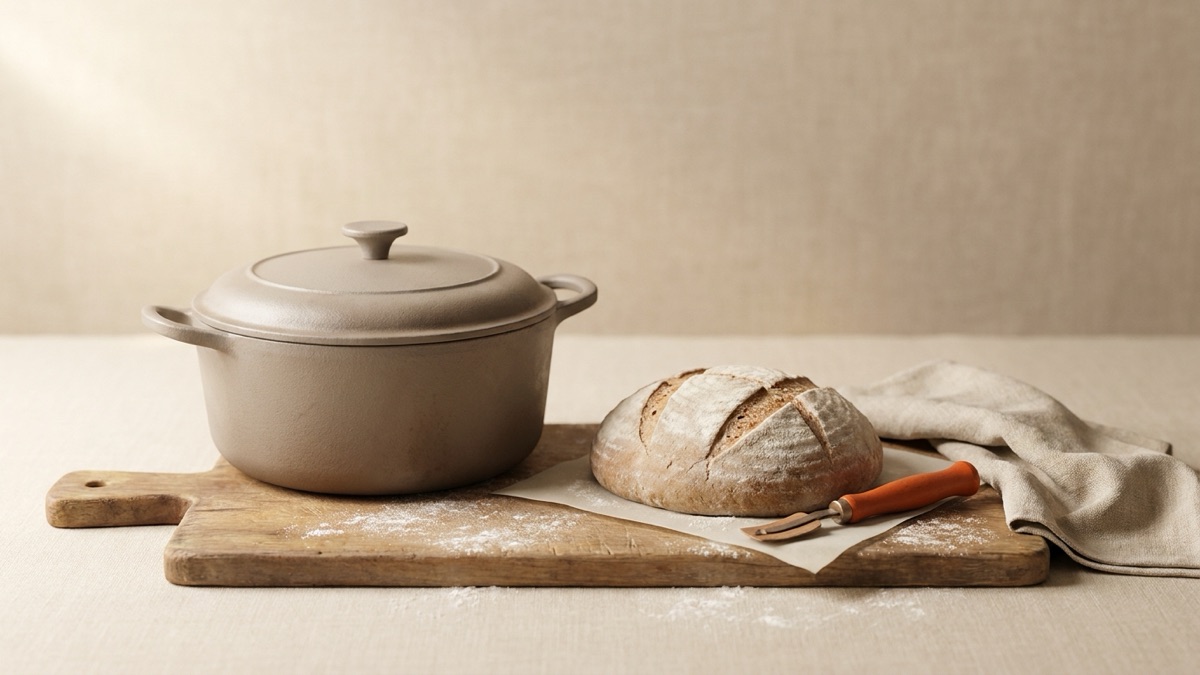
Preheat the dutch oven for sourdough: how long, and lid on or off?
Put the pot in the cold oven, turn the oven on, and give it a full 45 to 60 minutes. A heavy pot takes a while to heat through, and a pot that is not fully hot adds to a dense band at the base of the loaf. Recipes vary, and some preheat for as little as 30 minutes; the longer end is the safer habit with a thick pot.
Lid on or off? Preheat the lid with the pot. Both pieces go into the cold oven and heat together, so the whole pot is hot when the dough goes in. Lid on is the simplest way: there is one hot piece to lift out instead of two.
One check before you do any of this: some pots are not made to be heated empty. Look at the maker's instructions for yours. If it says no, use the cold start further down.
Try it
The bake planner works back from the time you want bread out of the oven and puts the full 45 to 60 minute preheat, the bake and the cooling wait on the clock, so the pot is hot when the dough is ready.
Dutch oven sourdough temperature
Bake at 450 to 500F (230 to 260C). If you are not sure where to start, 450F (230C) is a good default, and it is worth checking that your oven really reaches it.
Two adjustments cover most ovens:
- The crust darkens early while the inside lags. Your oven runs hot. Drop it about 25F (14C) once the lid comes off.
- The crust is pale at the end. Keep the temperature and bake uncovered 5 to 10 minutes longer.
Do not be shy about color. Deep brown is flavor. As long as the crust is not black and bitter, let it go a few minutes past comfortable.
Dutch oven sourdough bake time
Plan on about 20 minutes with the lid on and another 20 to 25 with it off. Some recipes run the uncovered part longer, up to about 35 minutes.
The clock gets you close. The loaf tells you when it is done: deep brown all over with no blond patches, and about 205 to 210F (96 to 99C) in the center on a probe thermometer. Sourdough internal temperature covers where to probe and what the numbers mean.
Then wait. The crumb is still setting when the loaf leaves the pot, so cool it on a wire rack for at least 1 to 2 hours. When to cut sourdough explains why cutting early leaves it gummy.
Dutch oven sourdough size: what fits
A 4 to 5 quart (about 4 to 5 liter) heavy lidded pot fits the usual single home loaf. A shallower combo style pot of about 3.2 quarts (3 liters), a skillet base with a deep lid, holds doughs from about 500 to 900 g.
Shape matters too. A pot with a smaller base helps a loaf rise tall instead of spreading, and a long oval loaf needs an oval pot.
Good to know
No pot at all? You can still bake good bread with another source of steam. Sourdough without a dutch oven covers the open bake.
Can you skip the preheat?
Yes, and for some pots you should. In a cold start, the almost fully proofed dough goes into the cold pot, the lidded pot goes into a cold oven, and the oven is set to the baking temperature. The bake time starts once the oven is up to temperature, usually 25 to 35 minutes from there, with the lid off for the last 5 to 10 to brown the top.
In side by side tests, the preheated pot gave more oven spring in one bake and nearly the same height in another, and the crumb looked much the same. Neither method is wrong. Ovens heat up differently, so expect to adjust a cold start over a bake or two.
When the bake goes wrong
| What you see | Often means | The one change |
|---|---|---|
| Black or very dark, hard base | Too much heat from below | Move the pot up one rack, or slide a baking sheet onto the rack below |
| Pale, blond crust | Short bake or a cool oven | Bake uncovered 5 to 10 minutes longer |
| Thick, hard, chewy crust | Too little steam early, or a long moderate bake | Keep the lid on for the full first 20 minutes |
| Score opened flat, no ear | Crust set early, or a proof or shaping issue | Lid on for 20 minutes, pot fully preheated |
| Dense band at the base | Underfermented; a pot not fully hot adds to it | Longer bulk first, then a full preheat |
For a base that keeps burning, a sprinkle of semolina or coarse flour under the dough adds a little insulation. Do not sit the pot directly on a baking stone. Burnt bottom on sourdough has more fixes.
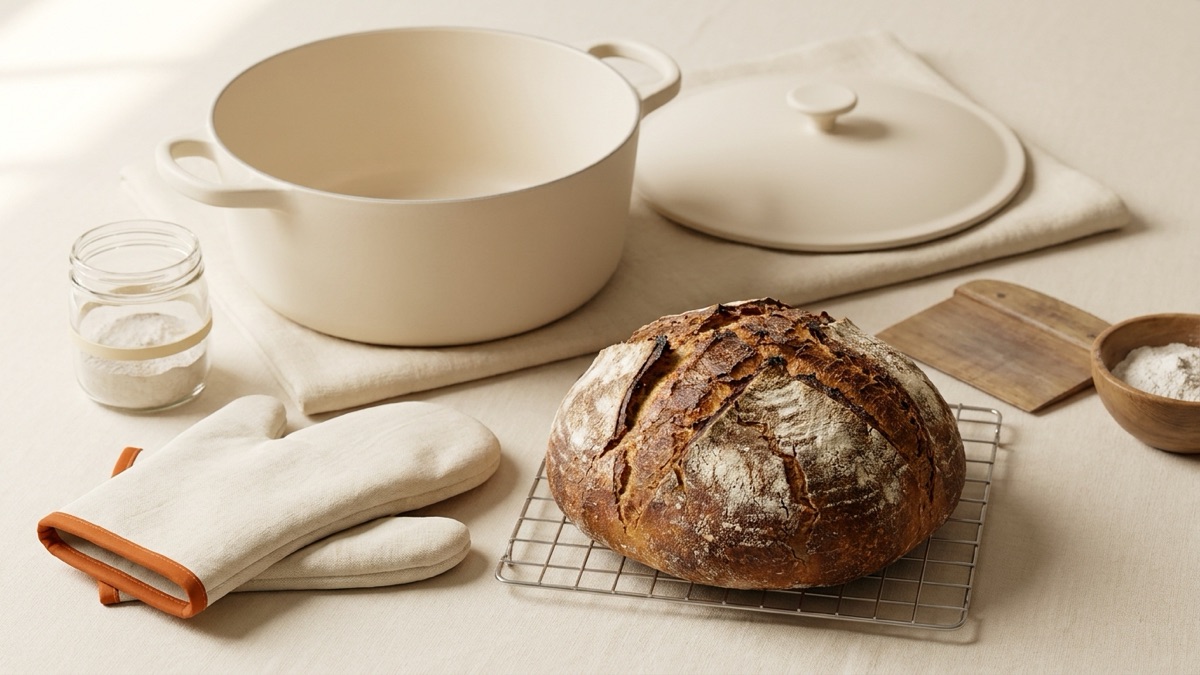
What to do this bake
- Check the maker's instructions: can your pot be heated empty?
- Put the pot and lid in the cold oven and preheat for 45 to 60 minutes.
- Turn the cold dough onto parchment, score it in one quick stroke and lower it in.
- Bake about 20 minutes covered, then 20 to 25 uncovered, until deep brown.
- Check the center reads about 205 to 210F (96 to 99C).
- Cool on a wire rack for at least 1 to 2 hours, and write down the times, the rack and the color.
What to change next bake
- Burnt or very dark base: bake. Move the pot up one rack or slide a baking sheet onto the rack below.
- Pale crust: bake. Uncovered 5 to 10 minutes longer.
- Crust dark early, inside lagging: bake. Drop about 25F (14C) once the lid comes off.
- Thick, tough crust: bake. Lid on for the full first 20 minutes.
- Dense band at the base: bulk first, 1 to 2 hours longer, and a full 45 to 60 minute preheat.
- Tall, deep brown, crisp all over, even crumb: Bake it again, and keep the same preheat, lid time and temperature.
The Loaf Scout app is built to read one straight-on photo of the cut face and give a proof call, a Loaf Score and the one change for next bake, the bake lever included. The rest of the last hour, from shaping to the first slice, is in the guides on shaping, scoring and baking.
A dutch oven is a small, steamy oven inside your oven. Get it fully hot, keep the lid on for the first 20 minutes, give the crust time to color, and change one thing at a time from there.
The pictures in this guide are AI-generated illustrations, not photos of real bakes; real loaves and starters vary, so trust the signs described in the text over any picture. Loaf Scout guides are general baking guidance, written from the sources named below, and every kitchen, flour and oven is a little different. Loaf Scout gives an AI read of one photo; your own eyes, nose and the poke test still count. A starter with fuzzy mold of any color, pink or orange streaks, or a rotten smell is thrown out and started again, whatever any page says.
Questions people ask
What temperature do you bake sourdough in a dutch oven?
Preheat the oven and pot to 450 to 500F (230 to 260C) and bake in that range. 450F (230C) is a good default. If the crust darkens early while the inside lags, drop the oven about 25F (14C) once the lid comes off.
How long do you bake sourdough in a dutch oven?
About 20 minutes with the lid on, then another 20 to 25 minutes with the lid off, until the crust is deep brown and the center reads about 205 to 210F (96 to 99C).
Do you preheat a dutch oven with the lid on or off for sourdough?
Preheat the lid along with the pot, so both are fully hot when the dough goes in. Lid on is simplest, because there is one hot piece to lift out of the oven instead of two.
What size dutch oven is best for sourdough?
A 4 to 5 quart heavy lidded pot fits the usual single home loaf. A shallower pot of about 3.2 quarts holds doughs from about 500 to 900 g.
Do you have to preheat a dutch oven for sourdough?
No, but check your pot first. Some pots should not be heated empty, and bread can be started in a cold pot in a cold oven instead. A preheated pot can give a little more oven spring.
Sources
- The Perfect Loaf: How to bake bread in a Dutch oven: www.theperfectloaf.com/how-to-bake-bread-in-a-dutch-oven/
- The Perfect Loaf: The ultimate guide to baking bread dough: www.theperfectloaf.com/guides/the-ultimate-guide-to-baking-bread-dough/
- King Arthur Baking: Bread baking in a Dutch oven: www.kingarthurbaking.com/blog/2017/02/21/bread-baking-dutch-oven
- King Arthur Baking: Baking in a cold Dutch oven: www.kingarthurbaking.com/blog/2017/07/05/baking-in-a-cold-dutch-oven
- King Arthur Baking: Baking bread with steam: www.kingarthurbaking.com/blog/2017/02/28/baking-bread-with-steam
Read next
Shaping, scoring and baking
How to Get an Ear on Sourdough
Starter care
Sourdough Starter: A Plain Guide to Keeping One
Hydration and flour
High Hydration Sourdough: When It Helps and When It Hurts
Bulk and proofing
How Long to Proof Sourdough After Shaping
Schedules and seasons
Sourdough in Winter: Keeping a Cold Kitchen Moving
Reading the crumb
The Sourdough Crumb: Read It Like a Baker