
Guides Loaf troubleshooting
Loaf troubleshooting
Every loaf did something right, and every fault points at one step. Start with the most common complaint, a dense and gummy loaf, then find the shape, crust or flavor problem you are looking at.
New here? Read Why Is My Sourdough Dense and Gummy? first. It separates the three usual causes, a loaf cut too soon, a dough that never built enough gas, and a bake that stopped short, and tells you which one to change first. The rest of this section takes one fault at a time, from flat loaves and pale crusts to a base that burns and bread that is too sour or not sour enough.
The short version: change one thing at a time. If you change bulk, water and the bake all at once, the next loaf cannot tell you which one helped. And before you blame the dough, wait at least 1 to 2 hours before cutting.
What went wrong with my sourdough?
Find the fault that bothers you most. Each one points at a single lever for next bake.
| What went wrong | Usual cause | The one change next bake |
|---|---|---|
| Gummy, but cut while warm | Cut too soon | Cooling: wait at least 1 to 2 hours, 2 to 3 for a loaf over 1 kg |
| Dense and gummy when cool, tunnels, a tight base | Underfermented | Bulk: 1 to 2 hours longer, until about 50 percent risen, domed and jiggly |
| Flat, spread and pale, no ear | Overproofed | Bulk or proof: end bulk sooner, or shorten the final proof |
| Flat and also tight and heavy | Too little gas | Bulk: longer |
| Slack and sticky from the start, then spreads | Too much water for the flour | Hydration: 2 to 3 percent less water |
| Pale crust, few blisters | Short bake, cool oven, or overproofed dough | Bake: 5 to 10 minutes longer uncovered, until deep golden brown |
| Black, hard base | Too much heat from below | Bake: move up a rack or slide a baking sheet underneath |
| No ear | Low tension, a straight-down score, a little overproofed | Shaping: more tension, then a shallow 30 to 45 degree score |
Where to start
- Dense or gummy: why is my sourdough dense and gummy.
- Flat or spreading: why is my sourdough flat reads the loaf first, because flat can mean too far or not far enough.
- Big holes or tunnels: big holes in sourdough, and underproofed vs overproofed if you are unsure which way the loaf went.
- No ear: how to get an ear on sourdough checks tension, proof, score and steam in that order.
If one fault explains the loaf, it is One change next bake. If several stacked up, it is A few changes next bake: start with the fermentation, then the bake and the cooling, one change at a time. And when unsure which way to adjust, lean toward a longer bulk; home bakers underproof far more often than they overproof.
Try it
Answer seven questions about the cut loaf in the crumb troubleshooter and get the proof call, the faults that fit, and the one lever to move next bake.
Heads up
Mold on a baked loaf means the whole loaf goes, not just the slice with the spot.
Related topics
- Reading the crumb: what the inside of the loaf says about each fault.
- Bulk and proofing guides: the fermentation behind most dense, gummy and flat loaves.
- Shaping, scoring and baking: the ear, the crust and the base.
Guides in this section
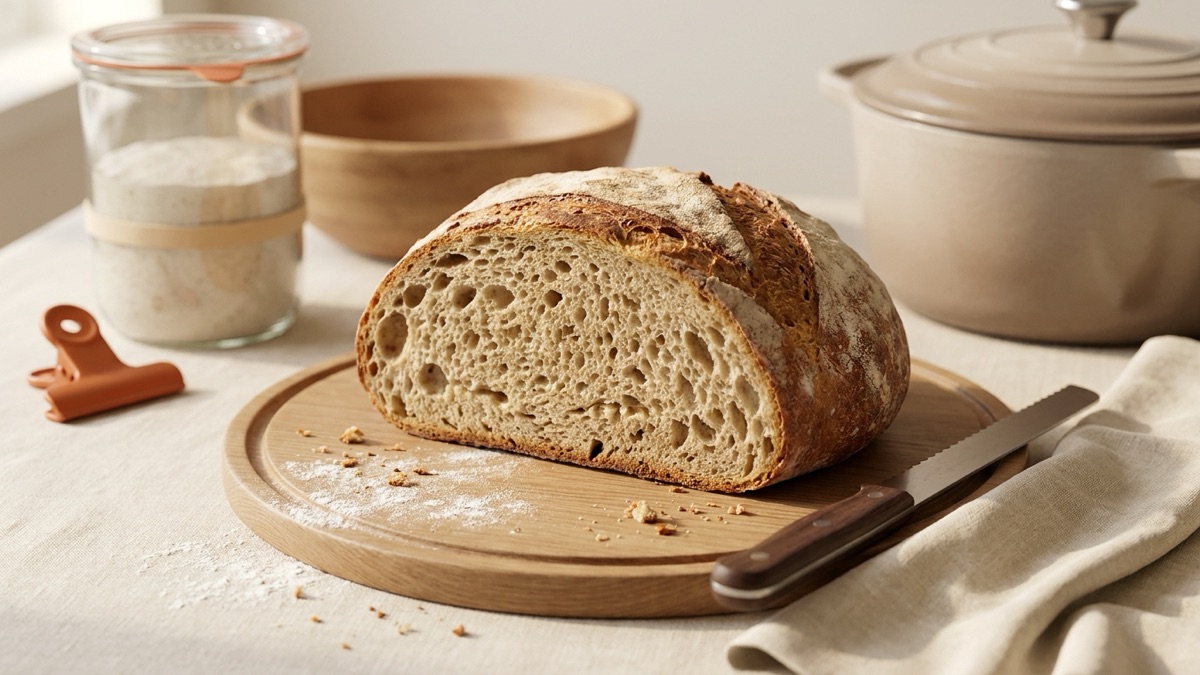
Loaf troubleshooting
Why Is My Sourdough Dense and Gummy?
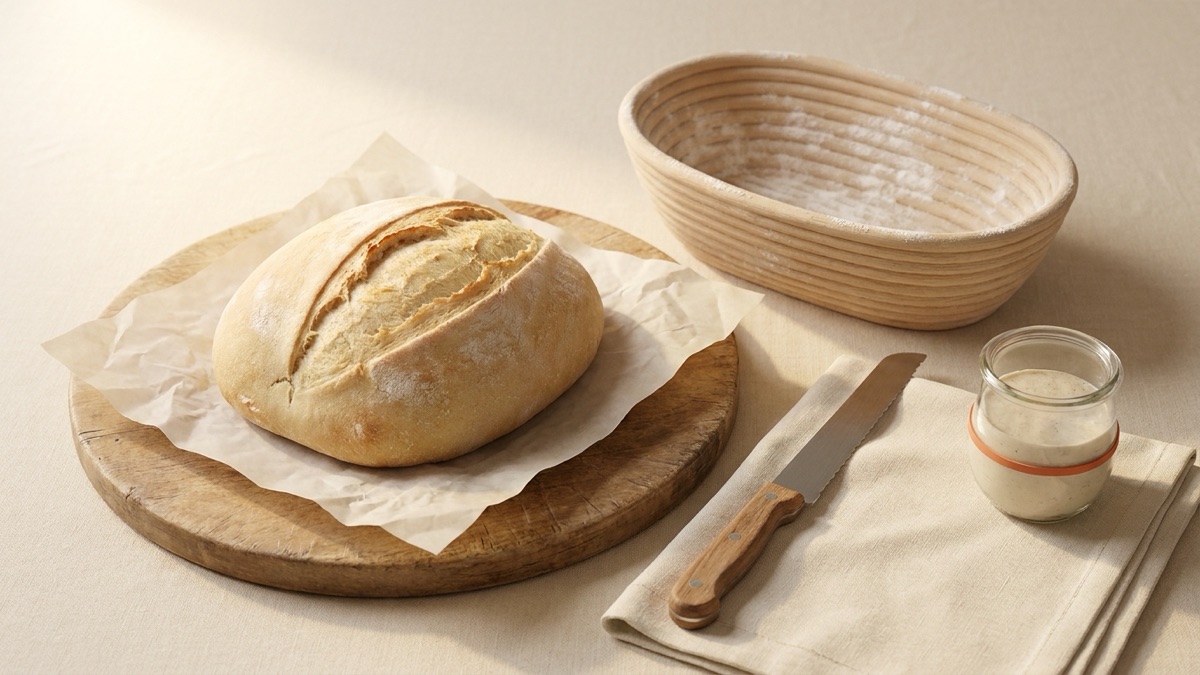
Loaf troubleshooting
Why Is My Sourdough Flat? Spreading Loaves, Explained