
Why Is My Sourdough Dense and Gummy?
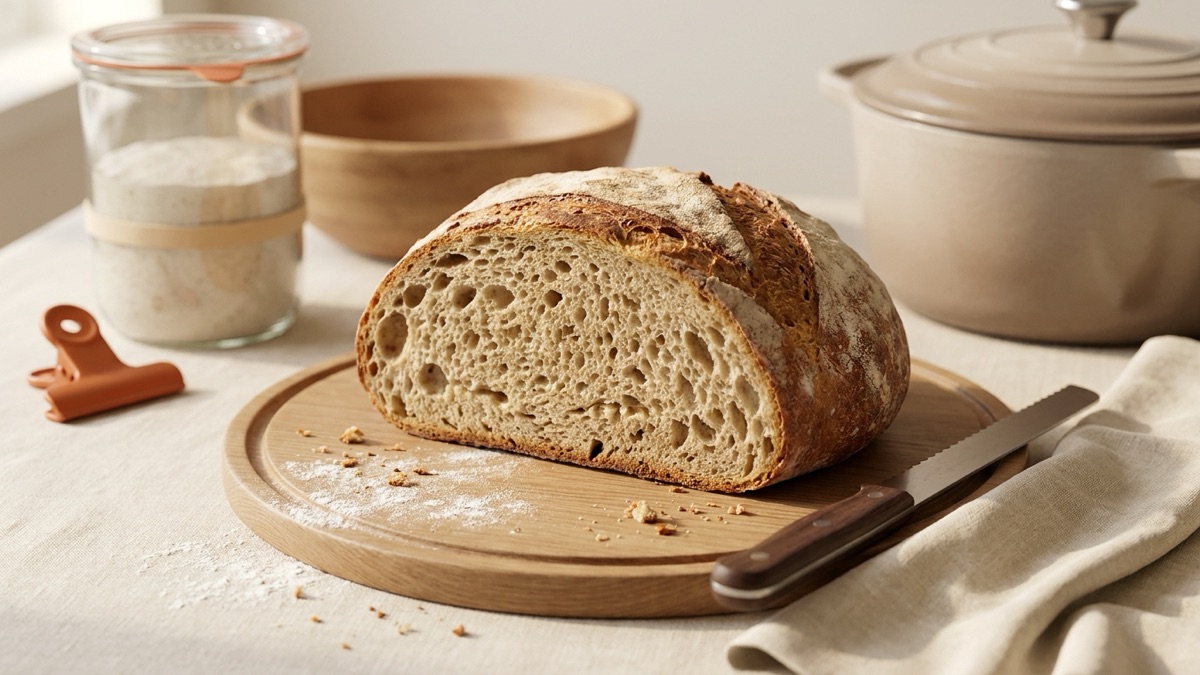
You waited all day, the crust crackled, and the knife came out with a smear of wet crumb on it. The slice is heavy, a little shiny and squashes like clay. Before you change the whole recipe, know that one of three things almost always did this, and only one of them needs a new dough.
Quick answer
A dense, gummy sourdough usually comes from one of three things, checked in this order: it was cut while still warm, the center was underbaked, or the dough was underfermented. Wait 1 to 2 hours before cutting, bake until the center reads 205 to 210F (96 to 99C), and if it is still tight and gummy, lengthen bulk.
The read
If the loaf was gummy only where it was still warm, the bread was fine and the knife was early. Wait at least 1 to 2 hours before cutting next time and leave everything else the same. If it is dense and gummy even when fully cool, with a tight band at the base, extend bulk by 1 to 2 hours instead.
Key takeaways
- Cutting a loaf while it is still warm is the most common cause of a gummy crumb, and the easiest to fix.
- Lean sourdough is baked through when the center reads about 205 to 210F (96 to 99C).
- Dense and gummy even when cool, with a tight band at the base, is underfermentation: lengthen bulk, not the fridge time.
- Whole wheat, rye and spelt bake tighter by nature; a tight crumb there is not a fault.
- Change one thing at a time, so the next loaf tells you what worked.
Why is my sourdough so dense?
A dense loaf is one that never got enough lift, or one whose crumb never got the chance to set. Gas from fermentation lifts the dough, the oven sets it, and cooling finishes the job. A break at any of those three steps leaves a heavy slice, and each one leaves a slightly different clue.
The order to check them in matters. Start with the easiest one to rule out, the cooling, then the bake, and only then the dough itself. If you change your bulk time when the real problem was a warm knife, the next loaf will be overfermented and still gummy.
How to tell which cause you have
Look at the slice, and think back to when you cut it. The pattern points to the step.
| What you see | Most likely cause | Lever | The one change |
|---|---|---|---|
| Gummy, sticky crumb, loaf was still warm when cut | Cut too soon | cooling | Wait at least 1 to 2 hours, longer for a big loaf |
| Gummy center, pale or blond crust | Underbaked | bake | Bake uncovered 5 to 10 minutes longer, to 205 to 210F (96 to 99C) |
| Tight band at the base, big tunnels above, gummy even when cool | Underfermented | bulk | Extend bulk by 1 to 2 hours, until about 50% risen, domed and jiggly |
| Gap under the top crust, denser crumb below | Underproofed | bulk | Extend bulk, light shaping flour, poke test before baking |
| Small, even, close holes, not gummy | Firm dough or whole grain | hydration | For a white loaf, raise water 3 to 5%; for whole grain, it is normal |
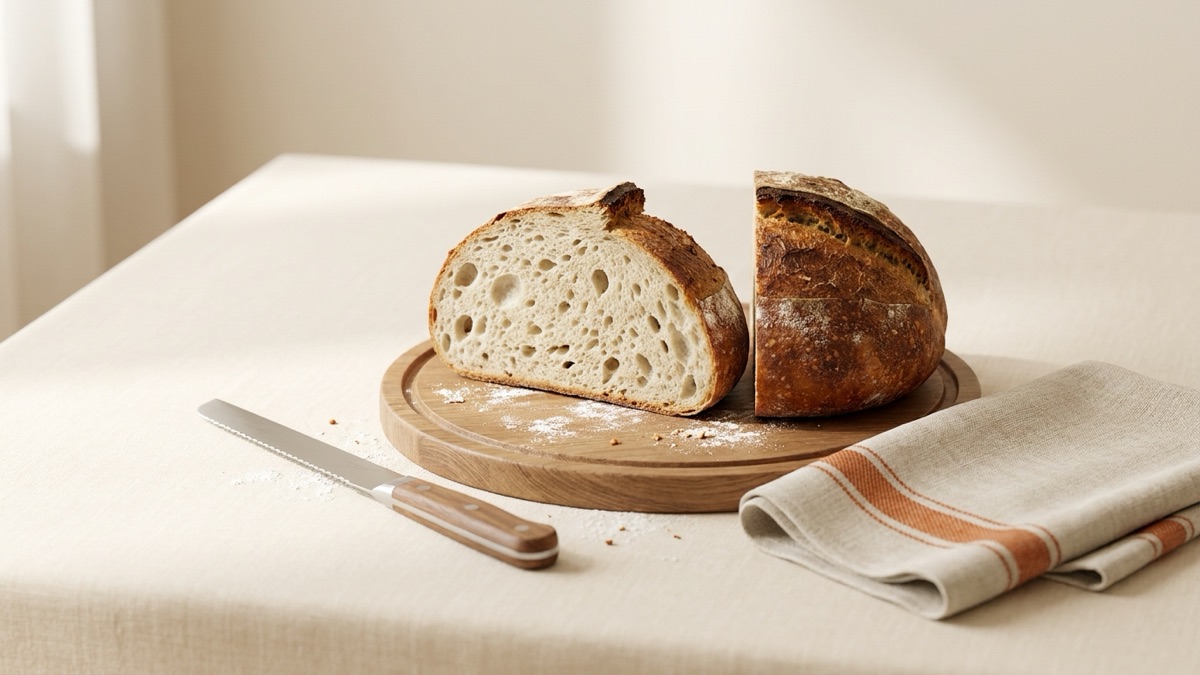
The line between "dense" and "gummy" helps too. Gummy is a texture: wet, shiny, compressed, sticking to the knife. Dense is a structure: small, closed holes and a heavy loaf. A loaf can be one without the other, and the fix depends on which you see.
Try it
Answer seven questions about the cut loaf in the crumb troubleshooter and get the proof call, the faults that fit, and the one lever to move next bake.
Why is my sourdough bread gummy?
Most often, because it was cut too soon. When a loaf leaves the oven, its center is still close to the boiling point of water and full of steam. The starches in the crumb have swollen and softened in the heat, but they have not set yet. As the loaf cools, moisture moves out toward the crust and the starches firm up into the springy crumb you want.
Cut it early and two things happen. Steam rushes out of the cut face, and the half-set crumb gets squashed by the knife into a dense, gummy layer. Plenty of loaves that look underbaked or underproofed were simply cut too soon.
How long to wait
- A regular round or oval loaf, around 700 to 900 g: at least 1 to 2 hours.
- A large loaf over 1 kg, or a tin loaf: 2 to 3 hours.
- Whole grain and rye: longer still. Many bakers wait until the next day for a dense rye.
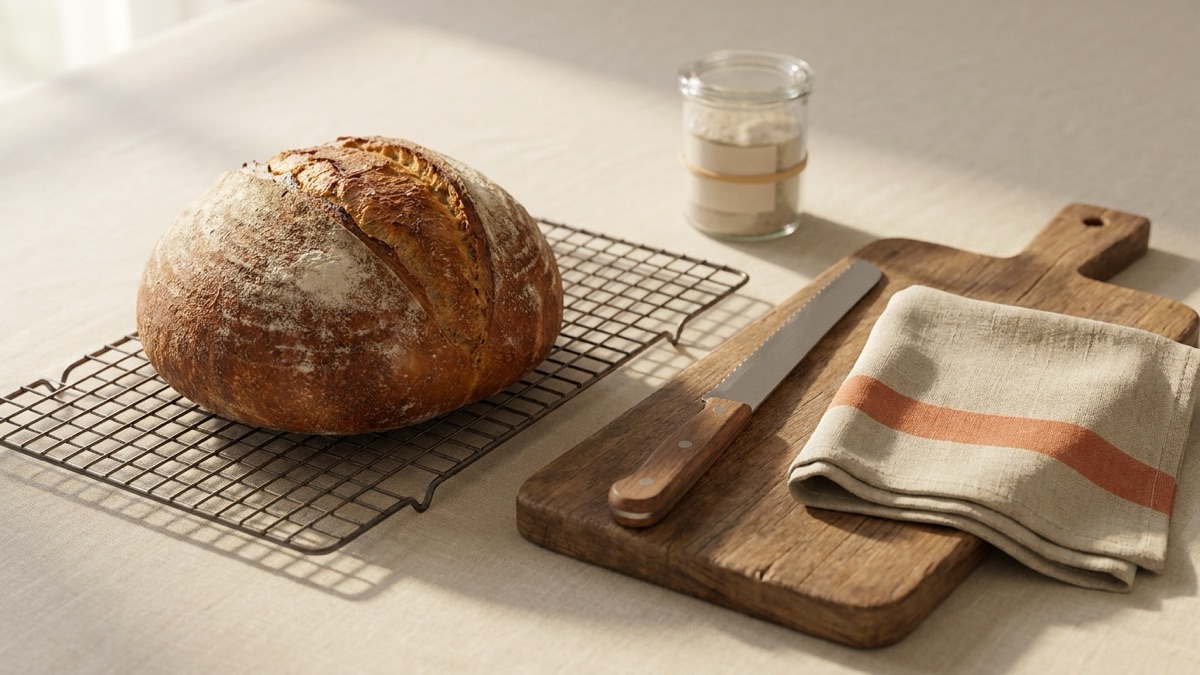
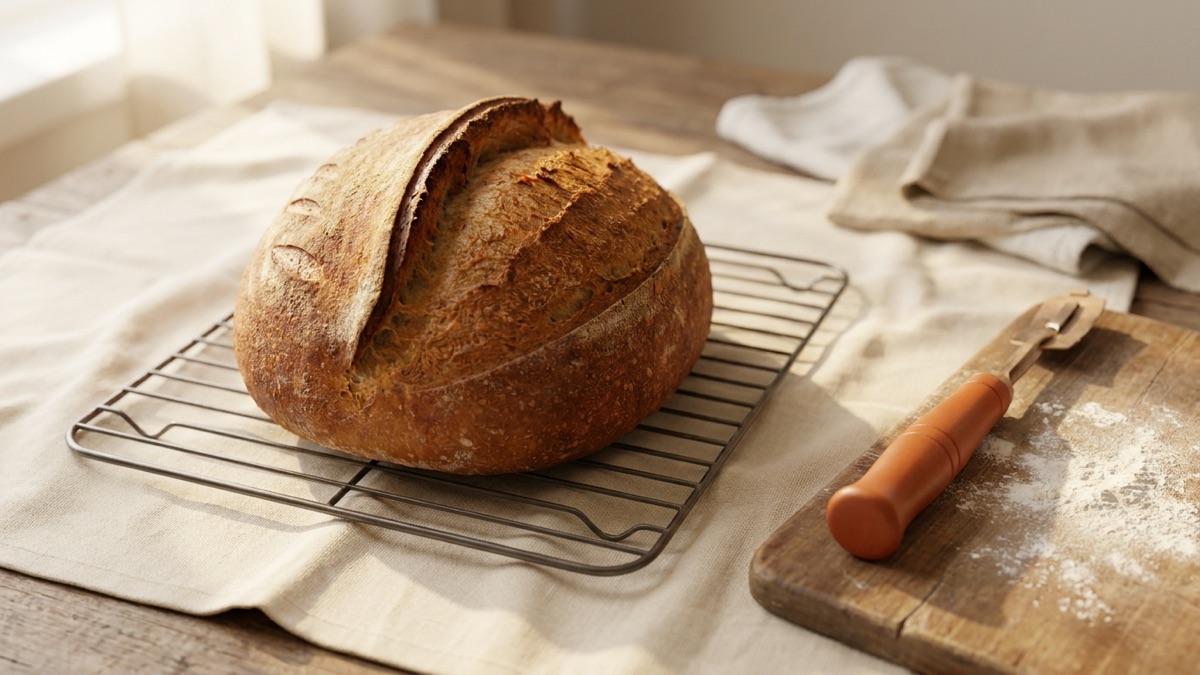
Cool it on a wire rack so air reaches the base; on a flat surface the bottom steams and goes soft. It is ready to cut when it feels barely warm or cool to the touch. If you want warm bread with dinner, bake it two to three hours ahead and rewarm it for a few minutes. When to cut sourdough goes through the wait in full.
Sourdough gummy inside, or gummy in the middle?
A loaf that is fine near the crust and gummy in the middle is telling you about the center, the last part to bake through and the last part to set as it cools. The edges are done long before the core is.
If you cut a loaf that felt cool on the outside and the middle was still gummy, it needed more time on the rack, especially a big one. If it was fully cool and the middle was still wet, the center did not get hot enough in the oven.
Check the center temperature
A probe thermometer settles the question in seconds. Lean sourdough is baked through when the center reads about 205 to 210F (96 to 99C). Push the probe all the way to the middle of the loaf, where it bakes last.
If it reads low, bake uncovered 5 to 10 minutes longer, until the crust is deep golden brown, and check that your oven really reaches 450 to 475F (230 to 245C). A pale crust and a gummy middle often show up together, because both come from a bake that stopped short. If the crust darkens early while the inside lags, drop the oven about 25F (14C) once the lid comes off and give the loaf longer. More on the crust side in why is my sourdough pale.
Tip
Deep brown is flavor. As long as the crust is not black and bitter, let the bake run a few minutes past comfortable. A well baked loaf has color all over with no blond spots, but the thermometer settles it.
Sourdough dense and gummy, even when cool
If you waited the full cool, the center read 205F (96C) or more, and the crumb is still heavy, tight and a little gummy, the dough did not build enough gas before it went in the oven. That is underfermentation, and it is very common at home. Cool kitchens, young starters and recipe times written for warmer rooms all slow bulk down.
The signs line up with the underproofed end of the proof scale:
- A dense, sometimes gummy band along the bottom
- Big irregular tunnels next to tight, closed crumb
- A gap under the top crust, often called fool's crumb
- A dramatic blowout along the score or the side
- Crumb that feels heavy and moist even when cool
The fix: a longer bulk
Extend bulk by 1 to 2 hours, until the dough has grown about 50 percent, looks domed and jiggles when you shake the bowl. Watch the dough, not the clock. A dough that finishes bulk in about 4 to 5 hours at 78F (26C) can take 8 hours or more at 68F (20C). If your kitchen is cool, bulk somewhere warmer, around 76 to 78F (24 to 26C).
A cold proof will not rescue it. An underfermented dough does not catch up in the fridge, so a dense bottom or a gap under the crust after a cold proof means a longer bulk at room temperature, not more fridge hours. How long to bulk ferment covers reading the dough in full, and underproofed vs overproofed shows how to tell which edge you are on.
Sourdough dense crumb, but not gummy
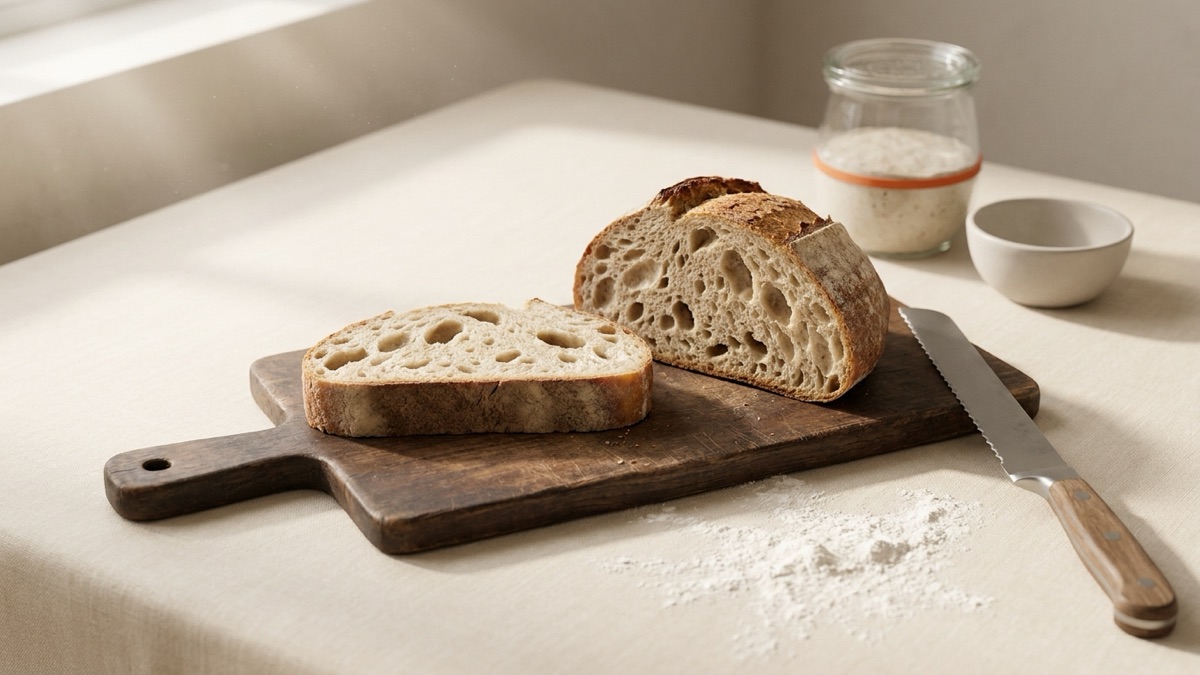
A crumb that is tight and even but dry and springy is a different thing from a gummy one. It is often a style, not a fault.
- A firm dough. A lower hydration dough bakes into small, close-set holes, a bit like sandwich bread. For a mostly white loaf you want more open, raise the water by 3 to 5 percent and let bulk run until the dough has grown about 50 percent. Lever: hydration.
- Whole grain flour. Whole wheat, rye and spelt bake tighter by nature. Rye in particular has little gluten strength and stays dense whatever you do. That is the flour, not you. Lever: none, or a little more water for whole wheat.
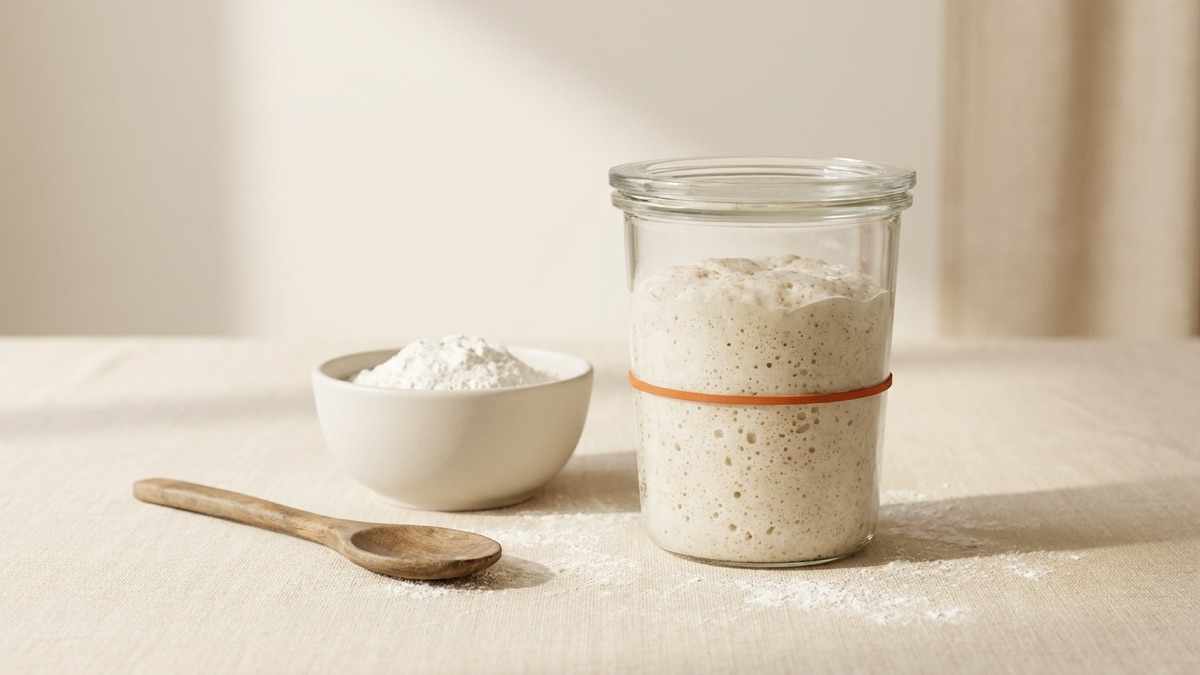
- A sluggish starter. A starter that has not doubled before you mix brings too little lift to the dough. Use it at or near its peak, when it has at least doubled from the band and has a domed or just flattening top. Lever: starter.
- A cold pot. A dense band at the base can grow worse when the pot or stone was not fully hot. Preheat it for a full 45 to 60 minutes. Lever: bake.
Heads up
A preheated pot is far hotter than it looks. Lower the dough in on a parchment sling, wear oven mitts, and lift the lid away from your face so the steam does not reach you.
What about overproofed dough?
Overproofing is the other edge, and it looks different. An overproofed loaf is usually flat, wide and pale, with a collapsed, lacy crumb and thin torn walls, rather than heavy and gummy. If your loaf spread out instead of up, read why is my sourdough flat before you add any time to bulk. Home bakers, especially early on, land on the underproofed side far more often, so if you are unsure, lean toward a longer bulk.
Flavor can shift too. A cold proof deepens the tang, so if the fixed loaf tastes sharper than you like, see sourdough too sour for ways to soften it without going back to a dense crumb. Every other whole-loaf fault, from a burnt base to a hard crust, is in the loaf troubleshooting guides.
What to do this bake
- Take the dough's temperature after mixing and write it down.
- Mark the start level on a straight-sided container and note how much the dough grows in bulk.
- Bake until the center reads about 205 to 210F (96 to 99C), with a deep brown crust.
- Cool on a wire rack for at least 1 to 2 hours, longer for a big loaf.
- Cut only when the loaf feels barely warm or cool, then look at the slice from top to bottom.
- Take one straight-on photo of the crumb in daylight, and change one thing.
What to change next bake
- Gummy only because it was cut warm: cooling. Wait at least 1 to 2 hours, 2 to 3 for a big loaf.
- Gummy middle and a pale crust: bake. Bake uncovered 5 to 10 minutes longer, to 205 to 210F (96 to 99C).
- Dense band at the base and tunnels above, gummy when cool: bulk, 1 to 2 hours longer, until about 50 percent risen, domed and jiggly.
- Dense bottom after a cold proof: bulk, at room temperature. More fridge time will not help.
- Tight, even crumb in a white loaf, not gummy: hydration, 3 to 5 percent more water.
- Tight crumb in whole wheat or rye: nothing to fix. That is the flour.
- Even crumb, springy slice, cut once cool: Bake it again, and write down the bulk time and dough temperature so you can repeat it.
A dense, gummy loaf is not a failed bake. It baked, it browned, and it told you which step to move. Wait for the cool first, check the center temperature second, and only then lengthen bulk, one change at a time. If you want a second read on the slice, the free crumb troubleshooter asks seven questions about the cut face and gives you a proof call and the one change for next bake.
The pictures in this guide are AI-generated illustrations, not photos of real bakes; real loaves and starters vary, so trust the signs described in the text over any picture. Loaf Scout guides are general baking guidance, written from the sources named below, and every kitchen, flour and oven is a little different. Loaf Scout gives an AI read of one photo; your own eyes, nose and the poke test still count. A starter with fuzzy mold of any color, pink or orange streaks, or a rotten smell is thrown out and started again, whatever any page says.
Questions people ask
Why is my sourdough gummy even after cooling?
If it is still gummy once fully cool, the cause is in the bake or the fermentation. Bake until the center reads about 205 to 210F (96 to 99C), and if it was baked through, extend bulk until the dough has grown about 50 percent, looks domed and jiggles.
How long should sourdough cool before cutting?
At least 1 to 2 hours for a regular round or oval loaf, 2 to 3 hours for a large loaf or a tin loaf, and longer still for whole grain and rye. It is ready when it feels barely warm or cool to the touch.
Is gummy sourdough underbaked?
Sometimes, but more often it was simply cut too soon. A probe thermometer settles it: lean sourdough is baked through at about 205 to 210F (96 to 99C) in the center.
Why is the bottom of my sourdough dense?
A tight, sometimes shiny band at the base usually means the dough was underfermented, so the heaviest part never got lifted. A pot or stone that was not fully preheated can add to it.
Will a longer cold proof fix a dense loaf?
No. An underfermented dough does not catch up in the fridge. If cold proofed loaves come out dense at the bottom, the fix is a longer bulk at room temperature, not more hours in the fridge.
Sources
- The Perfect Loaf: The best way to store bread: www.theperfectloaf.com/the-best-way-to-store-bread/
- The Perfect Loaf: The ultimate guide to baking bread dough: www.theperfectloaf.com/guides/the-ultimate-guide-to-baking-bread-dough/
- The Perfect Loaf: The ultimate guide to bread dough bulk fermentation: www.theperfectloaf.com/guides/the-ultimate-guide-to-bread-dough-bulk-fermentatio
- The Perfect Loaf: Proofing bread dough: www.theperfectloaf.com/guides/proofing-bread-dough/
Read next
Loaf troubleshooting
Why Is My Sourdough Flat? Spreading Loaves, Explained
Shaping, scoring and baking
How to Get an Ear on Sourdough
Reading the crumb
The Sourdough Crumb: Read It Like a Baker
Starter problems
Hooch on Sourdough Starter: What the Liquid Means
Starter problems
Sourdough Starter Mold: What It Looks Like, What to Do
Starter care
Sourdough Starter: A Plain Guide to Keeping One