
Fool's Crumb: The Gap Under the Crust
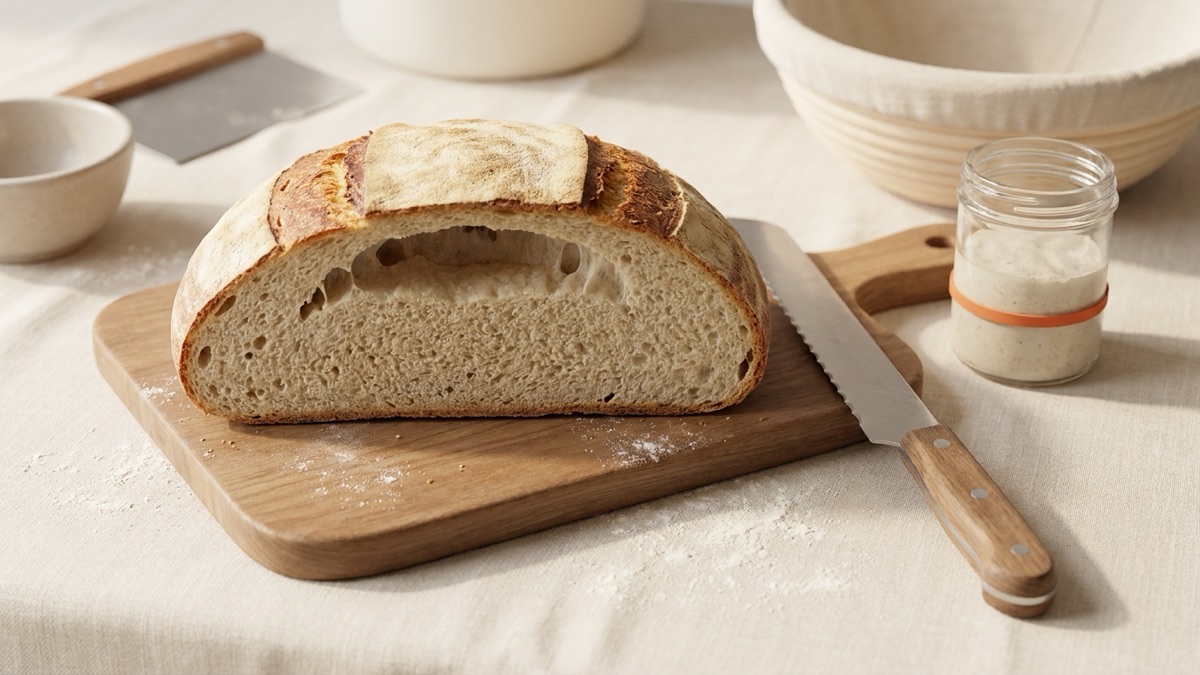
You cut the loaf and the top crust is sitting on a cave. There is a wide gap right under it, a few big holes, and then a slab of tight, heavy crumb underneath. From across the kitchen it looked like the open crumb you were hoping for. Up close, it is something else.
Quick answer
Fool's crumb is a wide gap under the top crust of a sourdough loaf, with a few big holes and dense, tight crumb below. It looks open, but it is a sign of underproofing: the top set in the oven while the gassy center kept pushing up. The fix is a longer bulk fermentation.
The read
A gap under the top crust with denser crumb below it means the dough was underproofed. Extend bulk by 1 to 2 hours, until the dough has grown about 50 percent, looks domed and jiggles, and leave everything else the same. If the loaf was also cut warm or baked pale, start with the fermentation and take the rest one bake at a time.
Key takeaways
- Fool's crumb is big holes in the wrong place: a gap under the top crust, tight crumb everywhere else.
- It is a sign of underproofing, not of a wet dough or a strong starter doing well.
- The lever is bulk. Extend it by 1 to 2 hours and watch the dough, not the clock.
- Too much flour on the surface while shaping can stop the layers sealing and add to the gap.
- A longer cold proof will not fix it. The fridge does not do the bulk for you.
What is fool's crumb in sourdough?
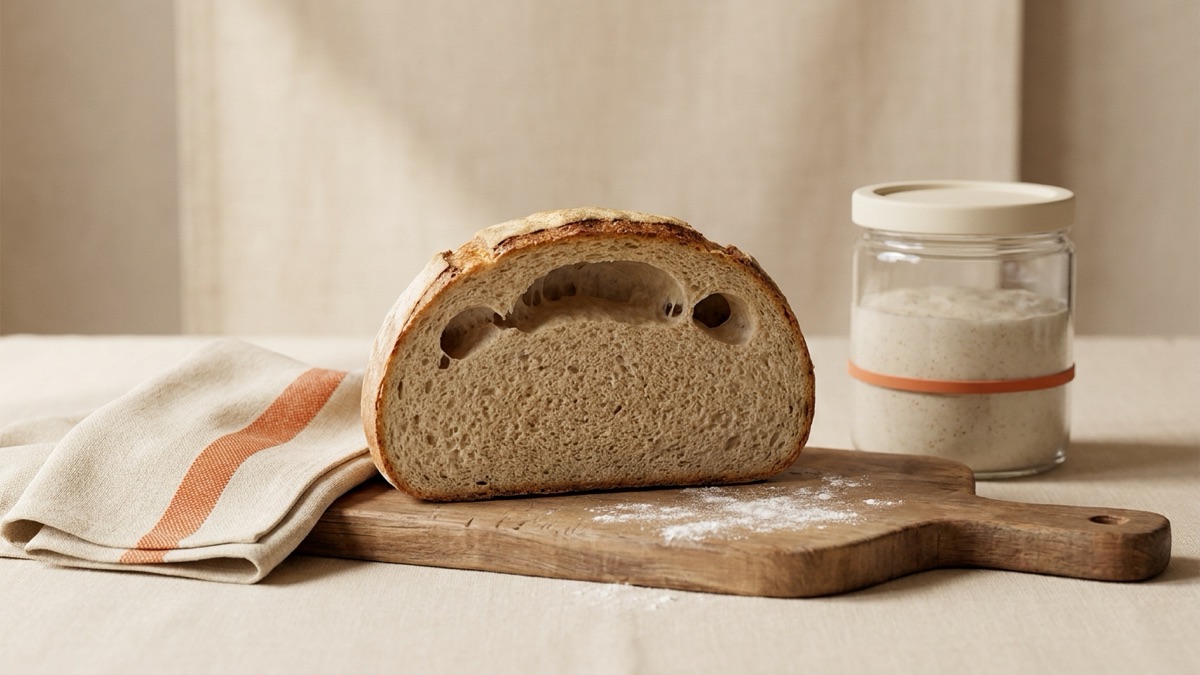
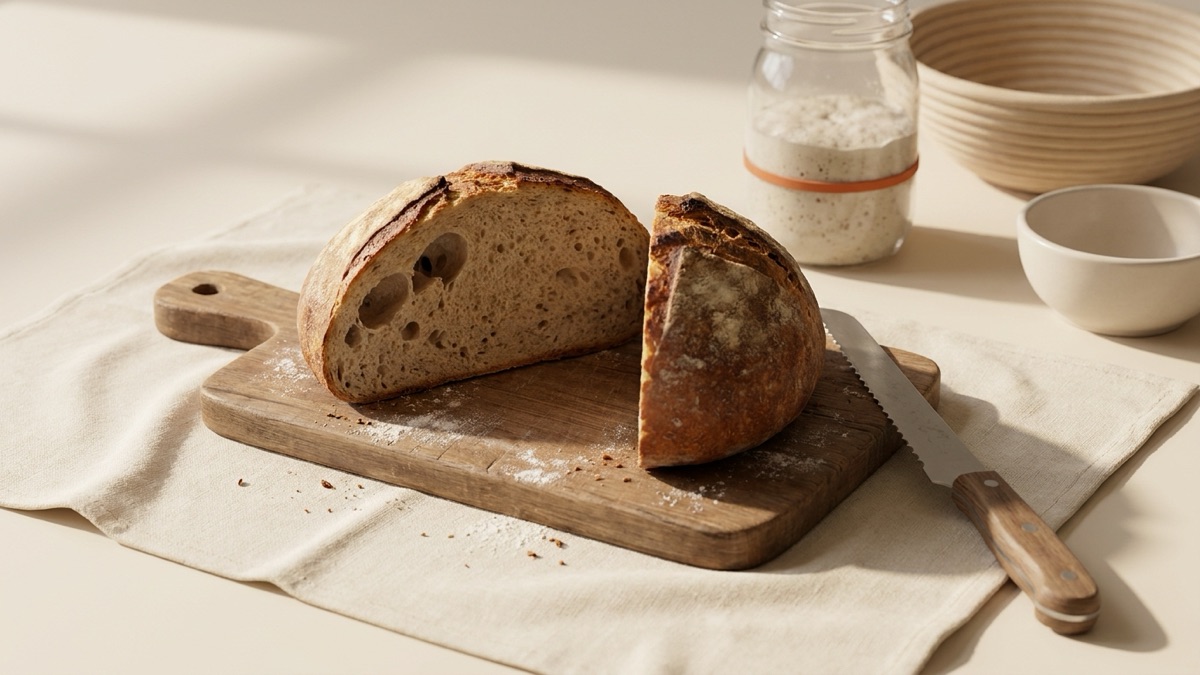
Fool's crumb (often typed "fools crumb") is the baker's name for a crumb that looks open at a glance and is not. The usual picture is a wide gap just under the top crust, as if the crust lifted away from the loaf, sometimes with one or two big holes near the top, and denser crumb below.
The name fits because it fools the eye. A photo shows dramatic holes. The slice in your hand tells the truth: the crumb between and under them is tight, heavy and often a little moist, even when the loaf is fully cool.
It sits at the underproofed end of the proof scale, next to a dense band at the base and big tunnels in tight crumb. The sourdough crumb guide shows where it falls among the other patterns.
What causes fool's crumb?
The dough went into the oven before it had built enough gas and strength. Bulk fermentation, the stretch between mixing and shaping, is where that gas gets made and spread through the dough. Cut it short and the gas is patchy.
In the oven, an underproofed dough tries to do the rising it had not done, fast and unevenly. The top crust sets in the heat while the gassy center keeps pushing up, and the two pull apart. What is left is a cavity under the crust and a tight, underfermented crumb beneath it.
Three things make it more likely:
- A short or cool bulk. A dough that finishes bulk in about 4 to 5 hours at 78F (26C) can take 8 hours or more at 68F (20C). Recipe times written for a warm room run short in a cool one.
- A young or sluggish starter. If the starter is not yet doubling on a steady schedule, the dough it raises runs behind too.
- Too much flour while shaping. A heavy dusting on the surface stops the layers of dough from sealing to each other, so a fold can open up into a gap as the loaf springs.
If you are unsure which way to go, lean toward a longer bulk.
Fool's crumb or a good open crumb?
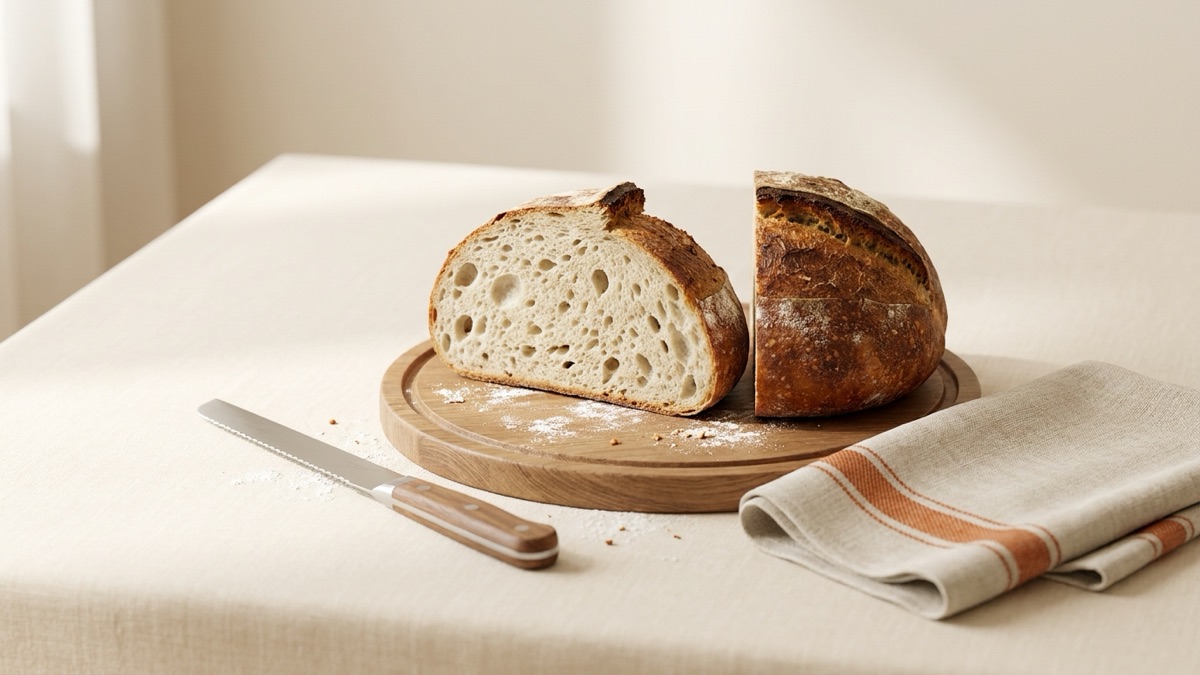
Both have big holes. The difference is everything around them. Read the slice from the top crust down to the base.
| Sign | Fool's crumb | Open, well proofed crumb |
|---|---|---|
| Where the holes are | A gap under the top crust, a few big holes up high | Holes of many sizes, top to bottom |
| Crumb between the holes | Tight, heavy, sometimes gummy | Light, springy, thin glossy walls |
| Base of the slice | Dense, compact band | As open as the rest |
| Score and shape | Tall, with a wild burst or a ripped side | Good height and a clean bloom |
| Verdict | One change next bake | Bake it again |
Try it
Not sure which column your loaf belongs in? Answer seven questions about the cut face in the crumb troubleshooter and get the proof call, the faults that fit, and the one lever to move next bake.
Sourdough big holes at the top: underproofed or overproofed?
Almost always underproofed, but there is one lookalike. An overproofed loaf can also show a large hole up near the crust, because the tired crumb sags away from the top.
Tell them apart by the rest of the loaf:
- Underproofed: tall, with explosive oven spring, a score that burst or ripped, scattered large holes with tight, dense areas between them, and a heavy base. The bottom crust may curve up at the edges instead of sitting flat.
- Overproofed: low and wide, with a pale crust, a score that barely opened, and a crumb of many small holes with thin, torn walls and no dense spots.
One is big holes in a strong, tight crumb. The other is a hole in a weak, sagging one. Big holes in sourdough walks through every version, and overproofed crumb covers the far end of the scale.
Good to know
Light, angle and a warm knife all change how a crumb looks. Cut a cool loaf straight down through the middle with a serrated knife and judge the slice in daylight, not the photo from the best side.
How to fix fool's crumb
The fix is time in bulk. Everything else is a helper.
Extend bulk and read the dough
Extend bulk by 1 to 2 hours next bake. It is done when these signs line up: the dough has grown about 50 percent, the edges dome where it meets the container, bubbles show on top and through the sides, and it jiggles like set gelatin when you shake the bowl. Any one sign alone can mislead you.
If your kitchen is cool, bulk somewhere warmer, around 76 to 78F (24 to 26C). A straight-sided container with the starting level marked makes the rise easy to see.
Go light on the shaping flour
Use the lightest dusting of flour on the counter, or shape on a lightly damp surface. Let the shaped dough sit seam side down for a minute before it goes into the banneton, so the seam seals. Shape with gentle, even tension and do not fold over big pockets of air.
Check the final proof with a poke
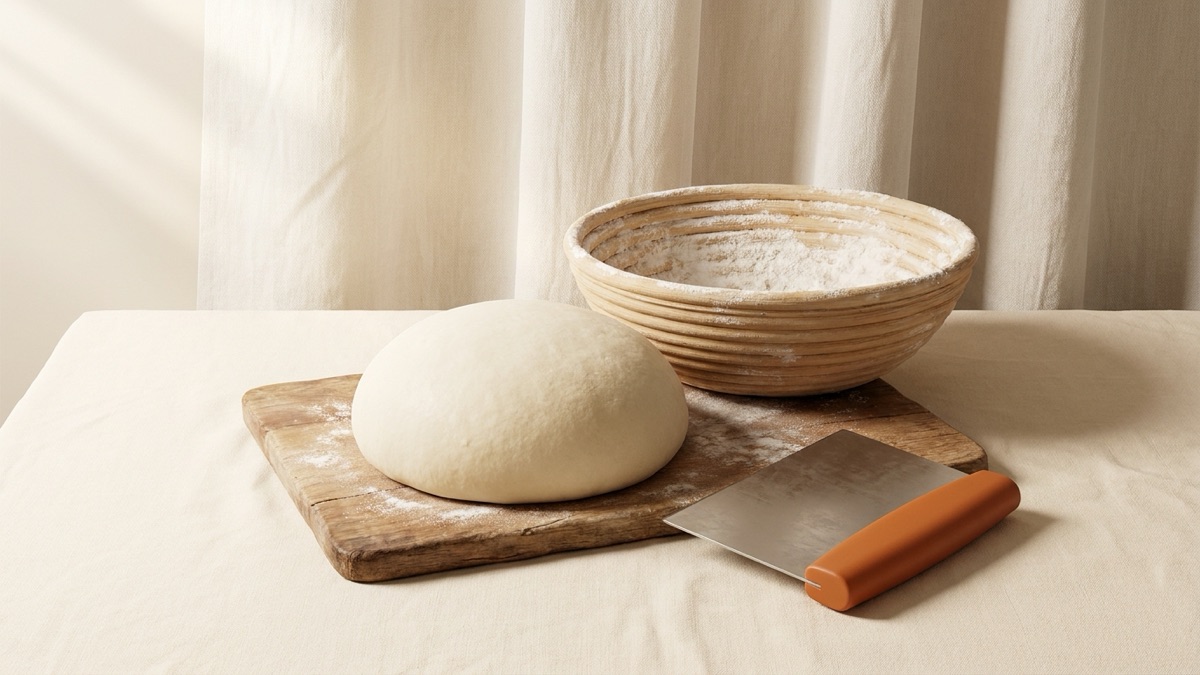
Before the dough goes in the oven, flour a fingertip and press about 1/2 inch (1 cm) into it. If the dent springs right back, give it more time. If it fills back slowly and leaves a small dimple, it is ready. Cold dough always springs back more slowly, so the test is less reliable straight from the fridge. The poke test guide covers the edge cases.
Heads up
A longer night in the fridge is not the fix. A dough that went into a cold proof underfermented will not catch up in the cold. If your cold proofed loaves keep showing a gap under the crust, the answer is a longer bulk at room temperature.
Is fool's crumb bread a failed loaf?
No. The loaf sprang, the crust browned and the dough had real strength. Those are wins, and they stay. A fool's crumb bread is one step short, not a brick, and the tight part toasts well.
Sourdough tunnels covers the close cousin of this pattern, where the big holes run through the middle instead of sitting under the crust.
What to do today
- Wait until the loaf is barely warm or cool, then cut straight down through the middle.
- Look at the whole slice: where the gap sits, and how tight the crumb is at the base.
- Press the crumb beside the biggest hole. Springy and light is an open crumb. Damp and heavy means the holes fooled you.
- Write down how long bulk ran, the dough temperature if you took it, and how much the dough grew.
- Take one straight-on photo of the cut face in daylight to compare with the next loaf.
- Pick one change for next bake and leave the rest alone.
What to change next bake
- Gap under the top crust, dense crumb below: bulk, 1 to 2 hours longer, until about 50 percent risen, domed and jiggly.
- Gap under the crust plus a spiral or pale seam in the crumb: shaping, a lighter dusting of flour so the layers seal.
- Gap under the crust after a long cold proof: bulk again, at room temperature. Leave the fridge time where it is.
- Gap under the crust and gummy when fully cool: bulk first. If you cut it warm, wait 1 to 2 hours next time before blaming the bake.
- Hole at the top of a flat, pale, lacy loaf: that is the other end. End bulk 1 to 2 hours sooner, or bulk cooler around 72F (22C).
- Even crumb top to bottom with holes of many sizes: Bake it again, and write down what you did.
The Loaf Scout app is built to read one straight-on photo of the cut face and give a proof call, a Loaf Score and the one change for next bake. Every other pattern on the cut face is in the guides on reading the crumb.
Fool's crumb is a near miss that looks like a win. The strength is already there. Give the dough another hour or two in bulk, keep the flour light, and the next slice should fill in from the crust to the base.
The pictures in this guide are AI-generated illustrations, not photos of real bakes; real loaves and starters vary, so trust the signs described in the text over any picture. Loaf Scout guides are general baking guidance, written from the sources named below, and every kitchen, flour and oven is a little different. Loaf Scout gives an AI read of one photo; your own eyes, nose and the poke test still count. A starter with fuzzy mold of any color, pink or orange streaks, or a rotten smell is thrown out and started again, whatever any page says.
Questions people ask
What is fool's crumb in sourdough?
Fool's crumb is a wide gap just under the top crust, as if the crust lifted away from the loaf, with denser crumb below it. It looks open at a glance, but it is a sign the dough was underproofed.
What causes fool's crumb?
The dough went into the oven before it had built enough gas. The top set in the heat while the gassy center kept pushing up and pulled away from it. Too much flour on the surface during shaping can add to it.
Is fool's crumb underproofed or overproofed?
Underproofed, in most loaves. The clue is the rest of the slice: a tall loaf with a burst score and tight, heavy crumb at the base. A hole near the top of a flat, pale, lacy loaf points to overproofing instead.
How do I fix fool's crumb?
Extend bulk by 1 to 2 hours, until the dough has grown about 50 percent, looks domed and jiggles. Use only a light dusting of flour when shaping, and proof until a floured poke fills back slowly.
Will a longer cold proof fix fool's crumb?
No. A dough that went into the fridge underfermented does not catch up in the cold. The fix is a longer bulk at room temperature, not more hours in the fridge.
Sources
- The Perfect Loaf: The ultimate guide to proofing bread dough: www.theperfectloaf.com/guides/proofing-bread-dough/
- The Perfect Loaf: The ultimate guide to bread dough bulk fermentation: www.theperfectloaf.com/guides/the-ultimate-guide-to-bread-dough-bulk-fermentatio
Read next
Reading the crumb
The Sourdough Crumb: Read It Like a Baker
Reading the crumb
Big Holes in Sourdough: Good Sign or Fault?
Hydration and flour
Sourdough Hydration Explained: What the Numbers Mean
Starter problems
Sourdough Starter Mold: What It Looks Like, What to Do
Schedules and seasons
Sourdough in Winter: Keeping a Cold Kitchen Moving