
Sourdough Hydration Explained: What the Numbers Mean
You read "75 percent hydration" in a recipe, mixed it exactly, and ended up with a puddle that would not hold a shape. Or the opposite: a stiff ball that baked tight. Both come down to one number, and once you know what it means, you can set it for your flour and your hands.
Quick answer
Sourdough hydration is the water in a dough as a percentage of the flour weight, with the starter counted as half flour and half water. Around 65 to 75 percent is the classic range. Beginners do best around 68 to 72 percent, and whole wheat and rye drink more water and bake tighter.
The read
If your dough was too sticky to shape and the loaf spread, bring the true hydration back to about 70 percent and leave everything else the same. If it held its shape and the crumb was even, that number works for you: bake it again, and raise the water 2 to 3 points only after two loaves in a row come out the same.
Key takeaways
- Hydration is water divided by flour, times 100, with the flour always counted as 100 percent.
- Count the starter: a starter fed equal parts flour and water is half of each, so most recipes are a few points wetter than the recipe line suggests.
- 65 to 75 percent is the classic range; under 65 is firm and easy, 75 to 85 is wet and stretchy, over 85 is very wet.
- Higher is not automatically better. A well fermented 70 percent loaf beats a poorly handled 85 percent one.
- Whole wheat and rye drink more water and bake tighter; spelt takes less water and slackens as it ferments.
What is sourdough hydration?
Hydration is the amount of water in a dough compared with the amount of flour, by weight. Bakers write it with the baker's percentage method: the flour is always 100 percent, and every other ingredient is a percentage of the flour weight. With 500 g flour and 375 g water, the dough is 75 percent hydration. With 500 g flour and 325 g water, it is 65 percent.
The number tells you how the dough will feel before you mix it, and it is the one figure that most changes whether the crumb comes out tight and even or loose and glossy. If the method is new to you, baker's percentage for sourdough goes through it line by line.
Weigh everything in grams; cups are too rough for a number this sensitive.
How to work out your sourdough hydration percentage
The formula is short: total water divided by total flour, times 100. The catch is the word "total". Most sourdough recipes list the starter as its own line, and the flour and water inside it are easy to forget.
A starter fed equal weights of flour and water is a 100 percent hydration starter, so half of its weight is flour and half is water. Counting it that way gives you the true hydration, which is how nearly every home recipe and our hydration calculator count it.
| Recipe line | Grams | Flour counted | Water counted |
|---|---|---|---|
| Bread flour | 500 | 500 | 0 |
| Water | 350 | 0 | 350 |
| Starter at 100% | 100 | 50 | 50 |
| Total | 950 | 550 | 400 |
The recipe looks like 70 percent (350 over 500). Counted properly it is about 73 percent (400 over 550). Three points is often the difference between a dough that shapes cleanly and one that sticks.
Salt sits in the recipe as its own baker's percentage, often around 2 percent of the flour, and it does not change the hydration.
Try it
Type your grams into the hydration calculator to see the true hydration with the starter counted, the water you need for the number you want, and the recipe scaled to any loaf size.
Sourdough hydration chart: the levels and how they feel
Here are the usual sourdough hydration levels for a mostly white dough, from firm to very wet.
| Hydration | Level | How the dough feels | What the crumb tends to do |
|---|---|---|---|
| Under 65% | Firm | Stiff, smooth, easy to shape | Tight and even, like a sandwich loaf |
| 65 to 75% | Classic | Soft, a little tacky near the top, needs a few sets of folds | Even to lighter and more varied |
| 75 to 85% | Wet | Slack, sticky, stretches far before it tears | Can open up well, with good fermentation and shaping |
| Over 85% | Very wet | Loose, almost batter at first, spreads easily | Can be very open and glossy, with practiced hands |
These feelings are for white flour. Change the flour and the same number feels different, which comes further down.
What is the best hydration for sourdough?
There is no single best number, only the best one for your flour, your hands and the loaf you want. The classic 65 to 75 percent range covers most home sourdough.
Higher is not automatically better. The open crumb people chase comes mostly from good fermentation and shaping, with water as a helper.
So pick a number by what you want from the loaf:
- Sandwich slices and toast: 65 to 70 percent gives a tighter, even crumb that holds butter.
- An everyday round loaf: 70 to 75 percent is soft, open enough and still manageable.
- A very open, glossy crumb: 78 percent and up, once your shaping and timing are steady. High hydration sourdough covers when it helps and when it hurts.
Sourdough hydration for beginners
If you are on your first few loaves, start around 68 to 72 percent true hydration with mostly white flour. That dough is soft enough to open up but firm enough to shape with real tension, and it gives you a loaf you can actually read.
A wet dough hides mistakes and magnifies them at the same time. It sticks, it is hard to shape with tension, and it spreads if the timing is a little off, so when it comes out flat you cannot tell whether the proof, the shaping or the water did it.
Once your loaves come out the same way twice in a row, raise the water by 2 to 3 points at a time. That way each step up is one change, and you know exactly what it did.
Hold some water back
Flour varies, even between bags of the same type. Protein, how finely it is milled and the humidity in your kitchen all change how much water it takes. So when you mix, hold back 25 to 50 g of the water and work it in slowly once the dough has come together.
If the dough turns loose and hard to handle before all the water is in, stop. You have found your flour's limit for today.
Tip
When the dough sticks, use wet hands or a bench scraper, not extra flour. Every handful of flour you dust on quietly lowers the hydration you meant to bake.
Sticky dough: too wet, or just not ready?
Sticky dough is the most common hydration worry, and it is not always too much water. A freshly mixed dough at 70 percent is sticky because the gluten has not built up yet. A few sets of stretch and folds through bulk turn the same dough smooth and tacky, without changing the water at all.
The water really is too high for your flour when the dough never firms up after several sets of folds and spreads into a puddle out of the banneton. Then drop it a few points next bake. For every other kind of stickiness, from wet hands to the counter itself, see why is my sourdough dough so sticky.
How flour type changes hydration
Every flour drinks a different amount of water, so treat any recipe hydration as a starting point for the flour in your bag.
| Flour | Water it takes | How the dough behaves | Crumb |
|---|---|---|---|
| Bread flour | More than all purpose | Strong, holds a shape well | Can open up well |
| All purpose | A little less than bread flour | Softer, turns loose sooner as you add water | A good everyday loaf |
| Whole wheat | Often 5 to 10% more | Feels firmer at the same number, rises less in bulk | Tighter, and that is normal |
| Rye | Sticky and paste-like at almost any number | Little gluten strength | Tight and dense by nature |
| Spelt | Less than wheat | Very stretchy, slackens by the end of bulk | Tender and soft |
Bread flour vs all purpose
Bread flour has more protein than all purpose, and higher protein flour absorbs more water. If you swap all purpose into a bread flour recipe, the same water will feel wetter, so start a few points lower and add the rest only if the dough asks for it.
Whole wheat and rye
Whole wheat, rye and spelt keep their bran and germ, and bran soaks up a lot of water. A whole wheat dough at 80 percent can feel about as firm as a white dough at 70 percent. When you swap some white flour for whole grain, add water too, often 5 to 10 percent more, and give the dough time to rest so the bran can absorb it. A whole wheat dough also rises much less in bulk than a white one, so judge it by how puffy and alive it looks, not the height. Whole wheat sourdough goes deeper.
Rye behaves differently again. It has little gluten strength and turns sticky and paste-like, so it bakes into a tighter, denser crumb whatever you do. That is its nature, not a fault, and adding more water will not make it open like white bread.
Spelt
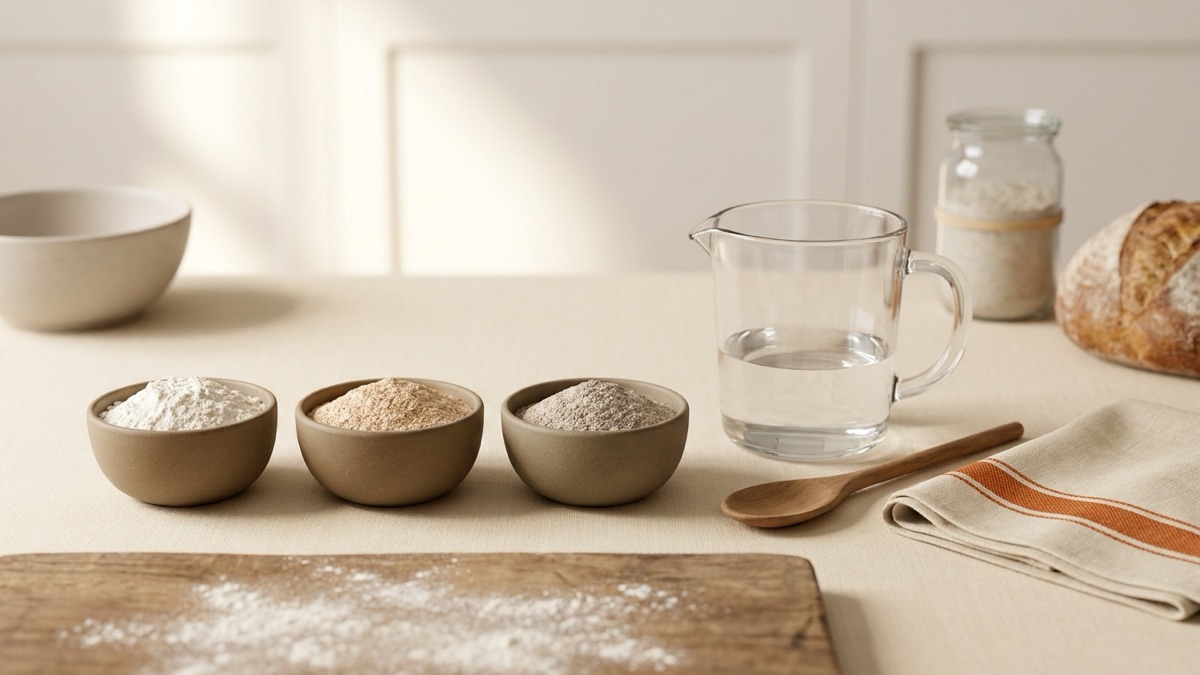
Spelt goes the other way. It takes less water than wheat and its dough is very stretchy, so it can feel strong at the start of bulk and slack by the end. Bring the water down when you swap spelt in, and build strength early with a few sets of folds.
Changing hydration without losing the loaf
Move hydration in small steps, and move only hydration. Raise the water and lengthen bulk in the same bake and the next loaf cannot tell you which one helped.
A wetter dough needs more strength built in, so give it a set or two more of stretch and folds early in bulk. Bulk is still where the loaf is made: watch for a dough that has grown roughly 50 to 75 percent, with domed edges, bubbles and a jiggle, whatever its water. The hydration and flour guides take each of these questions one at a time.
Good to know
Higher hydration is not a skill level you have to reach. Plenty of bakers make lovely loaves at 70 percent for years, and a tighter, even crumb is a style, not a fault.
What to do this bake
- Add up your recipe's true hydration, counting the starter as half flour and half water.
- Weigh the flour and water in grams on a kitchen scale.
- Hold back 25 to 50 g of the water and work it in slowly after the dough comes together.
- Stop adding water if the dough turns loose and hard to handle.
- Write down the number, the flour you used and how the dough felt at shaping.
- Change only one thing next bake.
What to change next bake
- Too sticky to shape, and the loaf spread: hydration. Bring true hydration back to about 70 percent. If the dough was easy to handle and still spread, check the proof before you blame the water.
- Tight, even crumb in a mostly white loaf you wanted more open: hydration. Raise the water by 3 to 5 percent and let bulk run until the dough has grown about 50 percent.
- Swapped in whole wheat and the dough felt stiff: flour. Add water, often 5 to 10 percent more, and rest the dough so the bran can soak it up.
- Spelt dough that went slack by the end of bulk: hydration. Bring the water down a few points and build strength early.
- A rye loaf that came out tight and dense: nothing to fix. That is rye. Let it cool fully before you cut.
- Two loaves in a row that came out the same and you liked them: Bake it again. Raise the water 2 to 3 points only if you want to see what it does.
Hydration is a dial, not a target to beat. Find the number that shapes well for your flour, keep it steady while you learn bulk and shaping, and move it a little at a time once the loaves come out the same. If your next loaf comes out heavy anyway, the water is rarely the first suspect: why is my sourdough dense and gummy covers the usual causes. And when you want a second opinion on the slice, the free crumb troubleshooter asks seven questions about the cut face and gives you a proof call and the one change for next bake.
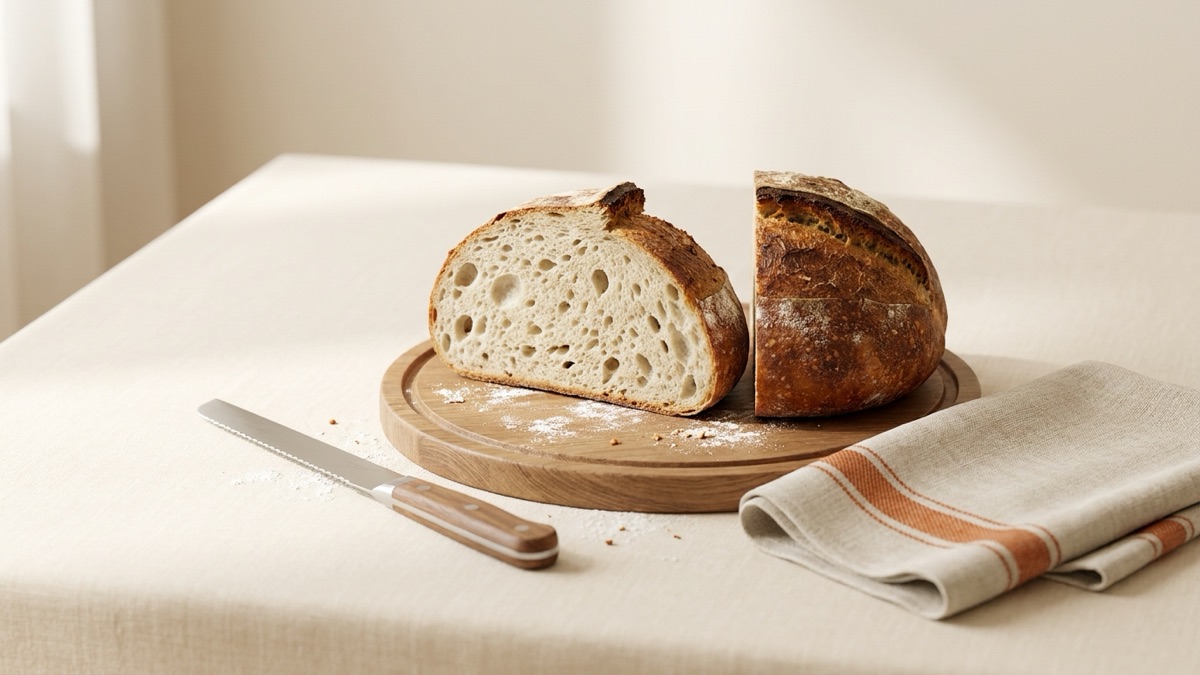
The pictures in this guide are AI-generated illustrations, not photos of real bakes; real loaves and starters vary, so trust the signs described in the text over any picture. Loaf Scout guides are general baking guidance, written from the sources named below, and every kitchen, flour and oven is a little different. Loaf Scout gives an AI read of one photo; your own eyes, nose and the poke test still count. A starter with fuzzy mold of any color, pink or orange streaks, or a rotten smell is thrown out and started again, whatever any page says.
Questions people ask
What is the best hydration for a beginner sourdough?
Start around 68 to 72 percent true hydration with mostly white flour. It is soft enough to open up but firm enough to shape with tension, and you can raise it by 2 to 3 points once two loaves in a row come out the same.
How do you calculate sourdough hydration with the starter?
Add the starter's flour to the recipe flour and its water to the recipe water, then divide total water by total flour and multiply by 100. A starter fed equal weights of flour and water counts as half flour and half water.
Is 80 percent hydration too high for sourdough?
Not for a practiced baker, but it is a lot for a first loaf of white flour. With whole wheat it can feel much firmer, because bran soaks up water, so 80 percent whole wheat may handle like 70 percent white.
Does salt count toward hydration?
No. Salt is its own baker's percentage, often around 2 percent of the flour, and it does not change the hydration number.
Why does my dough feel wetter than the recipe says?
Usually because the starter's water was not counted, or your flour takes less water than the recipe writer's. Count the starter, hold back some water at the mix and stop adding when the dough turns loose.
Sources
- The Perfect Loaf: What is dough hydration?: www.theperfectloaf.com/dough-hydration/
- King Arthur Baking School reference: Baker's percentage: www.kingarthurbaking.com/pro/reference/bakers-percentage
- The Perfect Loaf: Spelt sourdough bread: www.theperfectloaf.com/spelt-sourdough/
- The Perfect Loaf: The ultimate guide to bread dough bulk fermentation: www.theperfectloaf.com/guides/the-ultimate-guide-to-bread-dough-bulk-fermentatio
Read next
Hydration and flour
High Hydration Sourdough: When It Helps and When It Hurts
Reading the crumb
Big Holes in Sourdough: Good Sign or Fault?
Bulk and proofing
How Long to Bulk Ferment Sourdough
Schedules and seasons
Sourdough in Winter: Keeping a Cold Kitchen Moving
Loaf troubleshooting
Why Is My Sourdough Dense and Gummy?
Reading the crumb
The Sourdough Crumb: Read It Like a Baker